Fauna
Lynx lynx
The Eurasian lynx (Lynx lynx) is the largest wild cat found in Europe, recognisable by the black tufts on the tips of its ears and its short tail with a black tip. In Italy, it occupies a well-established north-eastern Alpine population and a western population, between Piedmont and the Aosta Valley, which has so far been confirmed only by sporadic sightings.
Buteo buteo
The buzzard (Buteo buteo) is a diurnal bird of prey belonging to the family Accipitridae, and is one of the most widespread and easily observed species in Italy. It inhabits wooded areas interspersed with open spaces, where it hunts mainly small mammals. In the Aosta Valley, it nests both in trees and on rock faces, within the upper limit of the forests.
Bearded Vulture
The bearded vulture (Gypaetus barbatus) is the largest bird of prey in the Alps, recognisable by its wingspan of nearly three metres and by itshabit, unique amongst vertebrates, of feeding almost exclusively on bones. Extinct across the Alps in the early decades of the 20th century, it has returned to breed in the Aosta Valley thanks to an international reintroduction project launched in 1978.
Capreolus capreolus
The roe deer (Capreolus capreolus) is the smallest member of the deer family found in the Alps, occurring from the valley floor up to the mountainous regions in environments on the edge of woodland and clearings. It is distinguished from red deer and fallow deer by its smaller size, short three-point antlers and the absence of a visible tail.
Cervus elaphus
The red deer (Cervus elaphus) is the largest wild ungulate found in the Italian Alps. Widespread across much of Europe, it was reintroduced to the Aosta Valley in the 1980s and is now present in stable populations in the western part of the region.
Salamander salamander
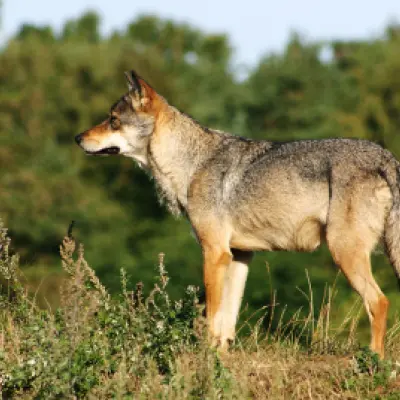
Canis lupus
Il lupo (Canis lupus) è un mammifero carnivoro della famiglia dei canidi, tornato a occupare naturalmente l'arco alpino occidentale a partire dagli anni Novanta dopo essere stato eliminato dal territorio nei primi decenni del Novecento. In Valle d'Aosta è oggi presente con diversi branchi distribuiti sull'intero territorio regionale, dove vive prevalentemente in foreste montane e praterie d'altitudine cacciando ungulati selvatici.
Asp viper
Marmota marmota
La marmotta delle Alpi (Marmota marmota) è un roditore della famiglia degli Sciuridi, diffuso nelle praterie d'alta quota dell'arco alpino sopra il limite del bosco. Vive in colonie organizzate attorno a sistemi di tane e trascorre gran parte dell'anno in ibernazione.
Vulpes vulpes
Chamois (Rupicapra rupicapra)
The chamois (Rupicapra rupicapra) is a ungulate of the Bovidae family found throughout theAlpine arc, the Apennines and other European mountain ranges, recognisable by the slender, hooked horns found in both sexes. Unlike the ibex, with which it shares its alpine habitat, it has never been reintroduced to the Western Alps, where the population has remained widespread and stable.
Ibex Goat
The Alpine ibex (Capra ibex) is a large wild bovid found in the Alps, recognisable by the curved, coiled horns present in both sexes, though much more developed in males. All current populations are descended from the core population that survived in the Gran Paradiso area, where the species was saved from extinction between the 19th and 20th centuries.