empty

Edited by:
Massimo Martini
Updated at: 21/03/2026
Access
All'uscita dello svincolo autostradale di Verrès entrare nella rotatoria e prendere la seconda uscita. Procedere in direzione del centro storico e, dopo 300m svoltare a sinistra imboccando la strada regionale per la Val d'Ayas. Seguire la regionale per 5,2 chilometri sino a Challand-Saint-Victor dove si svolta a sinistra verso il villaggio di Ville seguendo le indicazioni Ristorante Lo Djassi. PRoseguire per 200 metri sino ad incontrare l'ampio parcheggio 🅿️ del villaggio ove è possibile lasciare l'auto gratuitamente.
0h10' - 5,4km
Come arrivarci con GMaps
Come arrivarci con Apple Maps
Le indicazioni qui fornite sono state verificate alla data del rilievo dell’itinerario. Prima di partire è opportuno accertarsi che non siano sopraggiunte variazioni sostanziali sul percorso di accesso al punto di partenza. Pertanto, per ottenere indicazioni stradali aggiornate e dettagliate, consigliamo l’utilizzo delle app per la navigazione satellitare fornite da Google o Apple.
Introduction
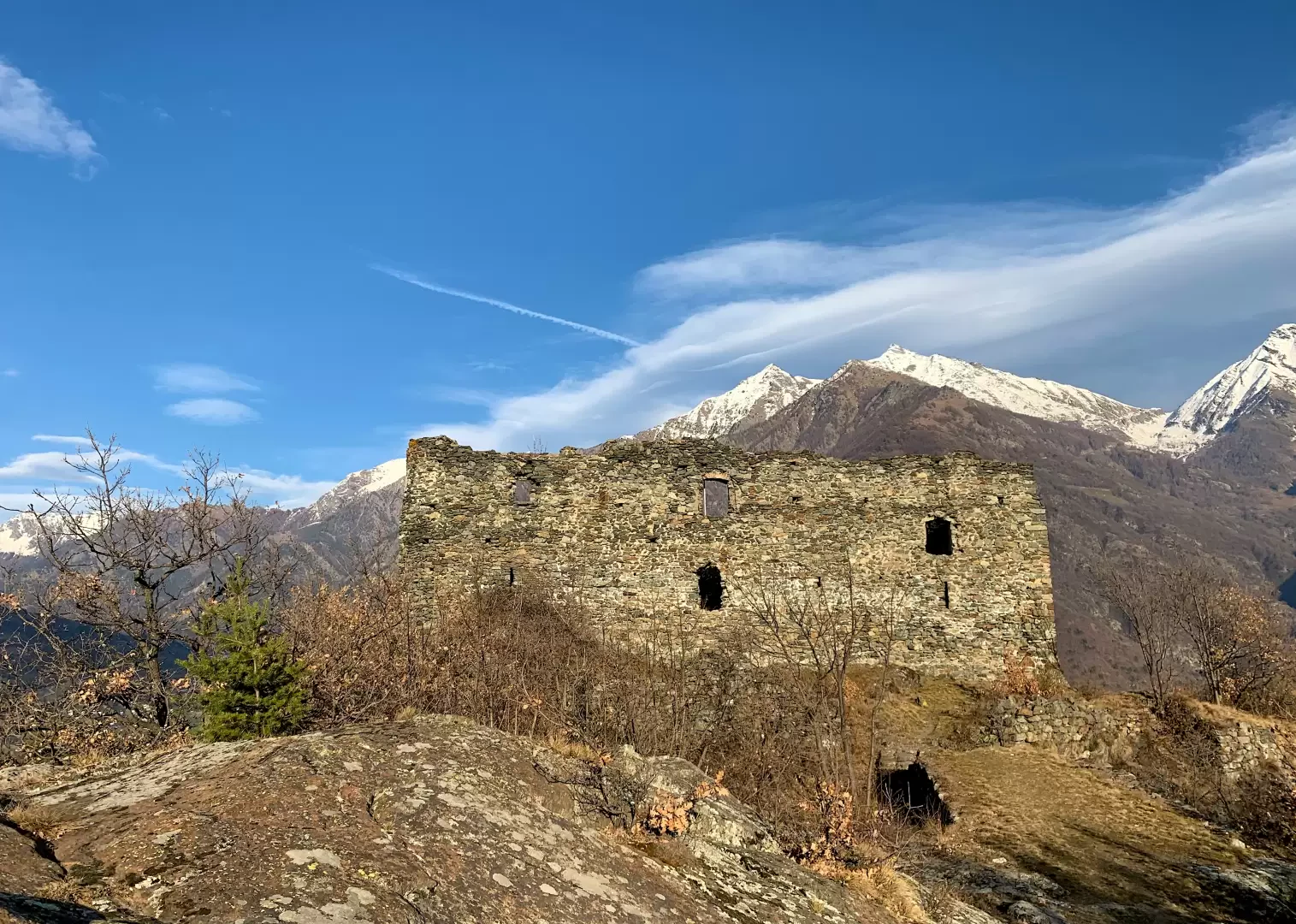
A loop route starting and ending at the hamlet of Ville, in the municipality of Challand-Saint-Victor, in the lower Val d'Ayas. The trail develops entirely along a mule track and through mixed woodland, with a modest elevation gain concentrated in the first half of the route, and leads to the ruins of Castello di Ville, the oldest manor of the Challant family, enfeoffed on 13 April 1200 by Thomas I of Savoy to Bosone II. The site preserves sections of the perimeter walls, arrow slits, a cistern and traces of frescoes in the chapel; the ruins are not accessible for safety reasons, but can be clearly read from the path that skirts them. Since 2017, the ascent to the castle — from the old dairy of Ville along waymarked trail — has been incorporated into the Castle's Trail, a 23–25 km trail running race linking the municipalities of Verrès, Challand-Saint-Victor and Montjovet. The surface is a partially eroded mule track with protruding roots and a short rocky section; the route is rated T2 and is walkable from late spring to early winter. Its short distance makes it suitable during the shoulder seasons, when snowfall renders higher elevations impractical. The chestnut (Castanea sativa), hazel and beech woodland that accompanies the entire route provides continuous canopy cover even in the warmest months.
Description
Photo gallery

Comments (0)
Sign in to leave a comment