Barmelle, from Dublanc

Edited by:
Massimo Martini
Updated at: 05/03/2026
Access
Leave the motorway junction at Pont-Saint-Martin and, after about 150 metres, turn left onto the road in the direction of Aosta. At the next roundabout, take the second exit and continue on the road for 2.2km (2.2km), passing through the village of Donnas until you reach another roundabout. Take the second exit still following the and continue for 3.0km (5.2km), bypassing the Fortress of Bard, until you reach another roundabout. At the roundabout, take the third exit and take the Valle di Champorcher regional road. Follow for 10.8km (16km), going up the valley and passing through the villages of Hône and Pontboset, until you reach the villages of Salleret and Dublanc. Continue for about 1km (17km) until you come to a small, free car park 🅿️ on the edge of the regional road in the locality of Dublanc, located just beyond the footpath departure post and used as the itinerary's starting point.
Access by public transport
The starting point is served by the Verrès - Pont-Saint-Martin - Champorcher bus line, which stops at Salleret, two hairpin bends below the starting point. For timetables, consult the website: www.vitagroup.en/linee-urbane-extra-vda
Distance and travel time
🕒 Travel time:23 minutes
📏 Distance:17 km
GPS Navigation
📍 How to get there by Google Maps
📍 How to get there with Apple Maps
ℹ️ Important note
The directions provided have been verified as of the date of the survey of the route. We recommend checking for possible changes in the route or road conditions before departure. Please consult Google Maps or Apple Maps for the latest information.
Introduction
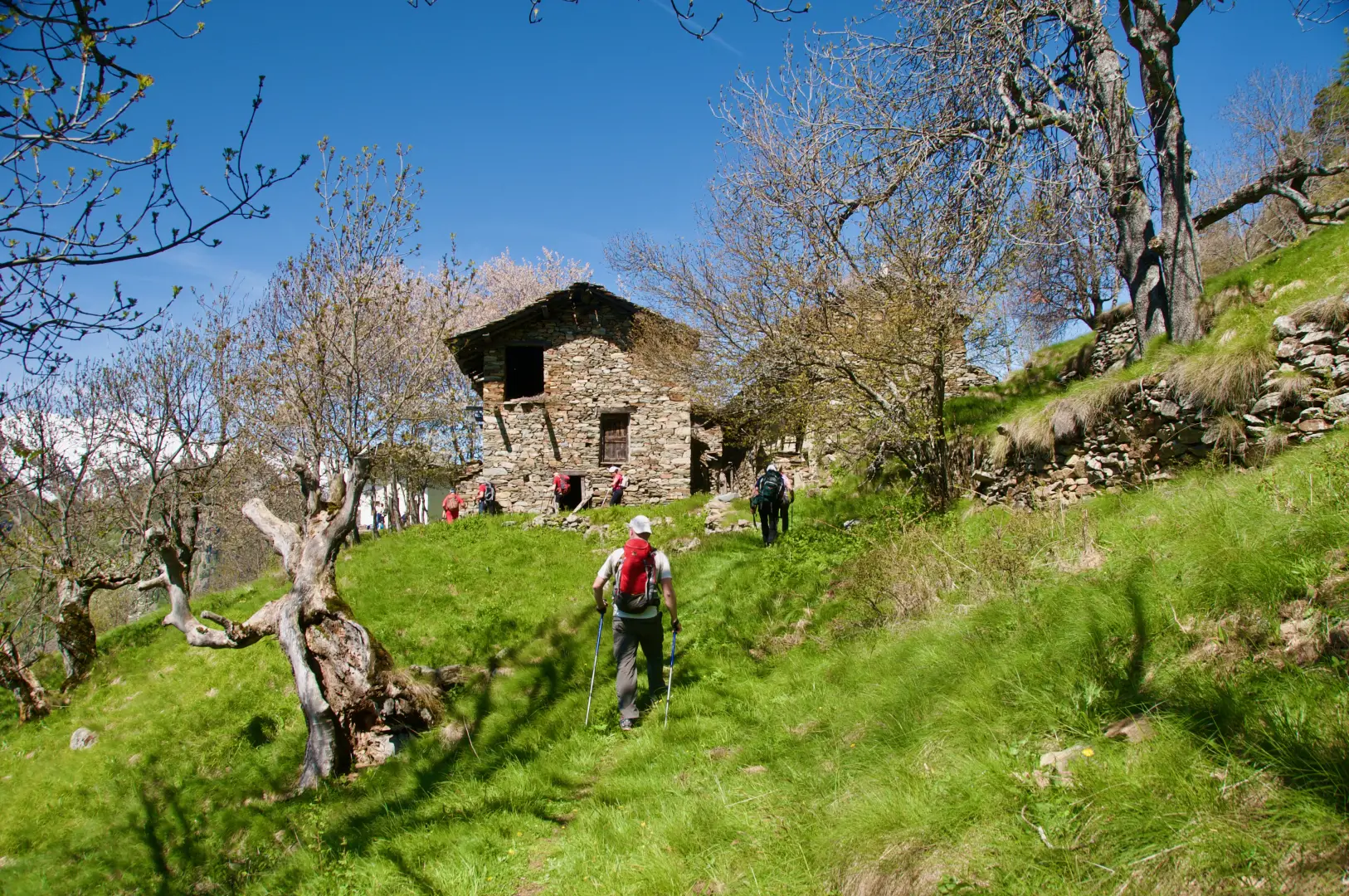
Barmelle is a village perched on the left orographic slope of the Champorcher valley. The village, positioned on a ledge on the slopes of the Tête du Mont, is a discreet, intimate and little-known place. The proposed hike follows a beautiful, stepped mule track, a testimony to the times when man had to live with the difficulties of the Alpe. The place name derives from barma, a term of pre-Celtic origin describing a shelter or vertical cliff that well describes the surroundings. The village, which gradually depopulated between the 19th and 20th centuries, is currently uninhabited.
Description
0h00' 0.00km
Leaving the car, cross the regional road to the signpost indicating the beginning of the Balisato path. We ascend a small asphalted road that soon becomes a footpath skirting the high block of Villa Franchini. Continue along the edge of the forest on a moderate slope until you come to a wooden footbridge that allows you to cross the impluvium created by a stream that descends from Grand-Rosier. Continue through the cool forest on a slight incline until you come to a cross and two characteristic rocks that anticipate the start of the section with the greater incline. The path now makes several hairpin bends, crosses another small impluvium and comes out at a point with a discreet view of the Champorcher valley. It proceeds for a stretch bordered by a wooden railing, then the path begins to climb up the steep slope. The mule track, with a series of hairpin bends, makes it possible to ascend the rocky crag, obviating the verticality by skilfully setting the slope of the pavement. A series of stone steps follow and a stream is reached beyond which the mule track increases in gradient and in some sections ⚠️ ropes appear to aid the ascent in case of slippery terrain, while the valley floor with the village of Pontboset also appears in view. The steepest part of the ascent is overcome, leading to the grassy terraces that anticipate the village. Now within sight of the buildings, we come to a stone fountain 💧 of fine workmanship and, after making a couple of turns, we reach the meadows in front of the chapel, dating from 1863, dedicated to Our Lady of Mount Carmel (1557m) 1h15' 1.65km . Wandering between the houses of the village, a sundial can be seen on the wall of the northernmost block of flats.
The descent follows the path taken on the ascent 0h45' 1.65km .
⚠️ Exposed sections: very slightly exposed a section of mule track (ropes to support)
Riferimenti Bibliografici
- I Monti di Aosta, Cogne, l'Avic e Champorcher - Luca Zavatta - L'Escursionista editore, Rimini, 2001
- Il Parco Nazionale del Gran Paradiso vol. 2 - Berutto Giulio - IGC Torino, 2000
Comments (0)
Sign in to leave a comment