Shisha Pangma

Edited by:
Massimo Martini
Access
Summit routes
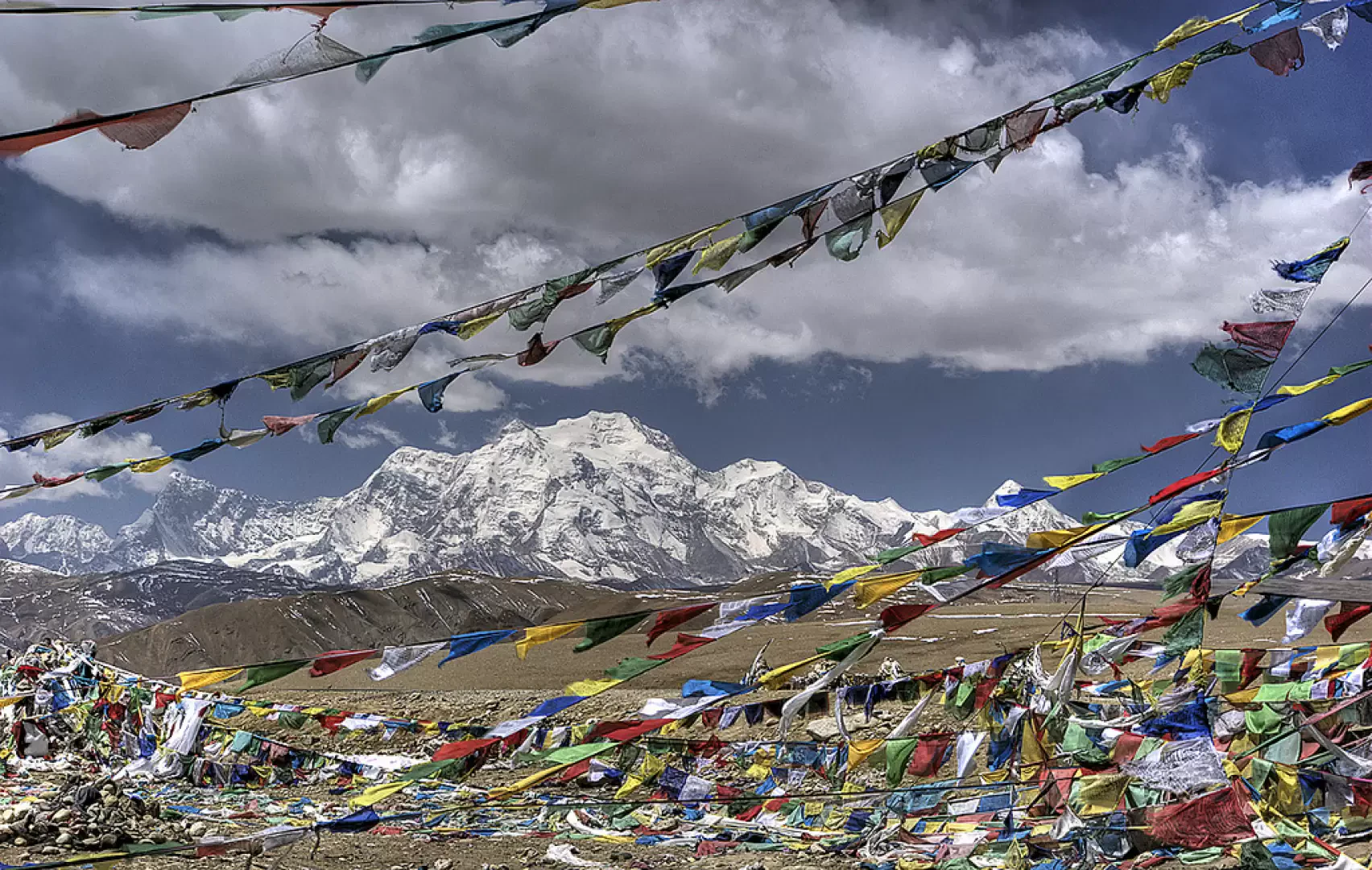
The Shishapangma can be reached by car up to a few hours from base camp, thanks to the Tibetan road network: the approach is the shortest of all eight-thousanders. Base camp is set up at about 5,000 metres on the north slope. The normal route ascends the north-west slope via the north ridge to the central summit, and continues - for those who want to reach the highest point - along the exposed ridge to the main summit. The south-west face, which is about 2,500 metres high, offers a series of challenging routes that have been opened in alpine style since 1982. The north face is the most popular and is considered among the least technical of all the eight-thousanders; the main obstacle remains the sharp and exposed final ridge between the central summit and the main summit.
Summer ascent routes
" from North Base Camp (5,000m), normal north face route, northwest ridge - PD - 4-6 weeks (including acclimatisation) - (normal route)
" from South Base Camp, south-west face route (Scott-Baxter-Jones-MacIntyre, 1982) - D+ - first ascent of south-west face in alpine style; direct ice gully
" from Base Camp south, Kukuczka-Hajzer route (1987) - D - west ridge, with ski descent from the final section by Kukuczka
" from Base Camp, south-west face route (Steck, 2011) - D+ - solo in 10h30m from advanced base camp; Piolet d'Or
Winter ascent routes
" normal north face route (5.000m) - PD - first winter ascent 14 January 2005 (mountaineering, Moro and Morawski)
Introduction
At 8,027 metres, Shishapangma is the fourteenth and lowest of the mountains above eight thousand metres. It rises entirely within Tibetan territory - and thus, politically speaking, within the People's Republic of China - some 120 kilometres northwest of Everest, in the Himalayas of southern Tibet. The Tibetan name means "the mountain range above the grassy plain" in Sanskrit it is known as Gosainthan. It was the last of the fourteen eight-thousanders to be climbed, on 2 May 1964, not because of the technical difficulties of its slopes - the normal route is among the most accessible of all the eight-thousanders - but because of the political closure of Tibet to foreigners, maintained by China throughout the previous decade. The first ascent was carried out by a great Chinese expedition led by Xǔ Jìng: ten mountaineers reached the summit at the same time. The mountain was only opened to foreign mountaineers in 1980. In 1982, a small British expedition - Doug Scott, Roger Baxter-Jones and Alex MacIntyre - opened the first route on the south-west face in perfect alpine style, in one of the founding episodes of modern light himalayering. The first winter ascent was made on 14 January 2005 by Simone Moro and Piotr Morawski; for Moro, it was the first winter ascent on an eight-thousandthousander by a non-Polish mountaineer. Shishapangma has a feature that distinguishes it from all other eight-thousanders: the summit ridge comprises two closely spaced summits - the main summit (8,027m) and the central summit (8,012m) - separated by a sharp and technically delicate ridge; many climbers have stopped at the central summit, generating a recurring dispute in the rankings of eight-thousanders.
Description
Geographical Background
The Shishapangma is located in the Tibetan Himalayas, within the Tibet Autonomous Region, a short distance from the Nepalese border. It is the highest peak completely within Chinese territory - a position that has long made it inaccessible to non-Chinese mountaineers - and it is also the only eight-thousand metre peak visible from the city of Kathmandu, some 75 kilometres south as the crow flies, on days with exceptional visibility. The massif extends in an east-west direction with three main summits: the main summit (8,027m) to the east, the central summit (8,012m) in the middle and the west summit at a lower altitude. The summit ridge connecting the two major summits is sharp, exposed and technically more challenging than the route to the central summit; this explains why many expeditions have considered it sufficient to reach the latter. The northern slope faces the Tibetan Plateau, open and windswept from inland Asia; the southern slope plunges steeply down into the valleys of Nepal.
Geologically, Shishapangma belongs to the Great Himalayan Sequence, with high-grade metamorphic rocks - gneisses and migmatites - emerging from the continental collision of the Indian and Eurasian plates. Compared to other eight-thousanders, Shishapangma is located further inland on the Tibetan Plateau, in a relatively isolated position that exposes it to cold, dry weather systems from the north, with different climatic characteristics than the more monsoon-exposed border mountains. This exposure to Tibet's cold winds makes the winter season particularly severe. The fauna of the plateau includes the snow leopard (Panthera uncia) and the Tibetan antelope (Pantholops hodgsonii), known as chiru, the symbol of Tibetan wildlife.
Mountaineering History
The Shishapangma remained the only eight-thousandth mountain ever attempted until 1964, as Tibet had been completely closed to foreigners since China extended control over it in 1950. The mountain had been known geographically since the 19th century, but no foreign expedition had ever been able to approach it. On 2 May 1964, a large Chinese expedition led by Xǔ Jìng reached the summit. Unlike all other first ascents of eight-thousanders, which were almost always carried out by a rope group of two or three mountaineers, the Chinese led ten mountaineers, including several Tibetan Sherpas, to the summit simultaneously. A bust of Mao Tse-tung also reached the summit with them. It was a numerically impressive expedition, carried out in the style of the great state expeditions, without supplementary oxygen. Thus fell the last remaining unclimbed eight-thousand metre peak, fourteen years after the first ascent of Annapurna.
The mountain was only opened to foreigners in 1980. The first successful western expedition was German, in the same year. The year 1982 brought what is considered the most alpinistically significant ascent in the history of Shishapangma: the British climbers Doug Scott, Roger Baxter-Jones and Alex MacIntyre opened the south-west face in perfect alpine style - three bivouacs on the ascent, one on the descent, no fixed ropes, no pre-prepared camps - with an approach that definitively proved that the great Himalayan faces could be tackled using the same methods as in the Alps. The climb won the first Boardman Tasker Prize for mountain literature. MacIntyre died a few months later, in October 1982, when he was struck by a rockfall on the south face of Annapurna.
In 1987, Jerzy Kukuczka and Artur Hajzer opened a new route to the west ridge; Kukuczka made a ski descent from the summit area. In 2004, the Frenchman Jean-Christophe Lafaille reached the summit solo on 11 December, in wintry conditions, with the aim of signing the first winter ascent. The matter turned out to be more complicated than expected: about a month later, on 14 January 2005, Simone Moro and Pole Piotr Morawski reached the summit via the South Yugoslavian route. The two claimed the first winter, arguing that astronomical winter begins on 21 December; Lafaille for his part claimed to have climbed in meteorological winter. The debate led to the codification of the rule now adopted by the international mountaineering community: a climb is winter if done entirely between 21 December and 21 March. Thus recognised, the first winter is that of Moro and Morawski; for Moro it was the second first winter ascent on an eight-thousander, after Shishapangma itself in 2005 - a curious fact: it was this event that gave rise to the rule. In 2011, Ueli Steck climbed the south-west face solo in 10 hours and 30 minutes from the advanced base camp, winning the Piolet d'Or of the year.
Main summit and central summit
The Shishapangma has a peculiarity that distinguishes it from all other eight-thousanders: the summit ridge comprises the central summit (8,012m) and the main summit (8,027m), separated by about 400 metres of sharp ridge. The normal route naturally leads to the central summit, which is also the most accessible. Many mountaineers who have climbed Shishapangma have stopped at the central summit, claiming to have climbed the eight-thousanders; the mountaineering community and the official recorders of ascents to the fourteen eight-thousanders now distinguish between those who have reached the main summit and those who have stopped at the central summit. This question is particularly sensitive in the context of the collecting ventures of the fourteen eight-thousanders.
Cultural context
The Shishapangma occupies a peculiar place in the history of eight-thousanders: it is the only one ever attempted by anyone before it was first climbed, because the political closure of Tibet made any approach impossible. Its first ascent in 1964 closed a chapter opened in 1950 with Annapurna - fourteen years of extraordinary mountaineering history, with first ascents of all the great peaks on the planet. The 1964 Chinese expedition was radically different from all others: it was not an elite expedition but a collective demonstration of national ability, in line with the political values of the time. This difference in style from western expeditions makes the story of Shishapangma unique among all eight-thousanders. The 1982 British ascent by Scott, Baxter-Jones and MacIntyre remains one of the milestones of light himalayering, still cited today as a prime example of alpine style applied to the great Himalayan faces.
Accessibility and Attendance
The Shishapangma can be reached much more quickly than other eight-thousanders thanks to the Tibetan road network, with the approach being reduced to a few days from Kathmandu by land. Climbing permits are issued by the Chinese authorities and are subject to bureaucratic and political restrictions that vary over the years. The main season is spring (April-May) and autumn (September-October). The northern slope is by far the most popular.
Information
Height: 8,027m (main summit); middle summit: 8.012m
Alternative name: Gosainthan (Sanskrit); Shishapangma = "the mountain range above the grassy plain" (Tibetan)
Mountain group: Southern Tibetan Himalayas - Langtang Himal
Alpine chain: Himalaya
Typology: massif/two main peaks
Protected area: none
First ascent: 2 May 1964
First climbers: Chinese expedition led by Xǔ Jìng (ten mountaineers)
First winter ascent: 14 January 2005
First ascenders in winter: Simone Moro, Piotr Morawski
Vice book: absent
Commune/s: Tibet Autonomous Region, People's Republic of China
Valley(s): Tibetan Plateau (N); Himalayan valleys to Nepal (S)
Mountaineering difficulty: PD (normal route); D+ (southwest face)
Average elevation gain: 3.027m (from Base Camp north)
Recommended period: April-May; September-October
Prevalent exposure: N (normal route); S-W (southwest face)
Presence of glaciers: yes
Presence of equipped sections: yes (fixed ropes on the normal route)