Mont Blanc du Tacul

Edited by:
Massimo Martini
Access
The itineraries to Mont Blanc du Tacul can be reached mainly from the Aiguille du Midi, via the cable car from Chamonix, or from the Rifugio Torino on the Italian side, which can be reached by the Mont Blanc Skyway from Courmayeur. Both starting points provide access to the Glacier du Gigante and the Col du Midi, from which the main itineraries towards the summit develop. The normal route covers the north-west slope and the west ridge with PD difficulty, on steep and crevassed glacial terrain; the numerous technical routes open on the east slope - goulotte, couloirs and pillars - cover a wide spectrum of difficulty, from D to ED. The summit is also an obligatory stage on the Trois Monts route to Mont Blanc. The north face is exposed to the objective danger of collapse of seracs: such events have claimed victims on several occasions, with serious episodes in 1974, 2005 and 2008.
Summer ascent routes
" from Col du Midi (3,532m) via north-west face and west ridge - PD - 1 day - (normal route)
" from Rifugio Torino (3.375m) to Col des Flambeaux, NE side and Goulotte Gervasutti - D - 1 day -
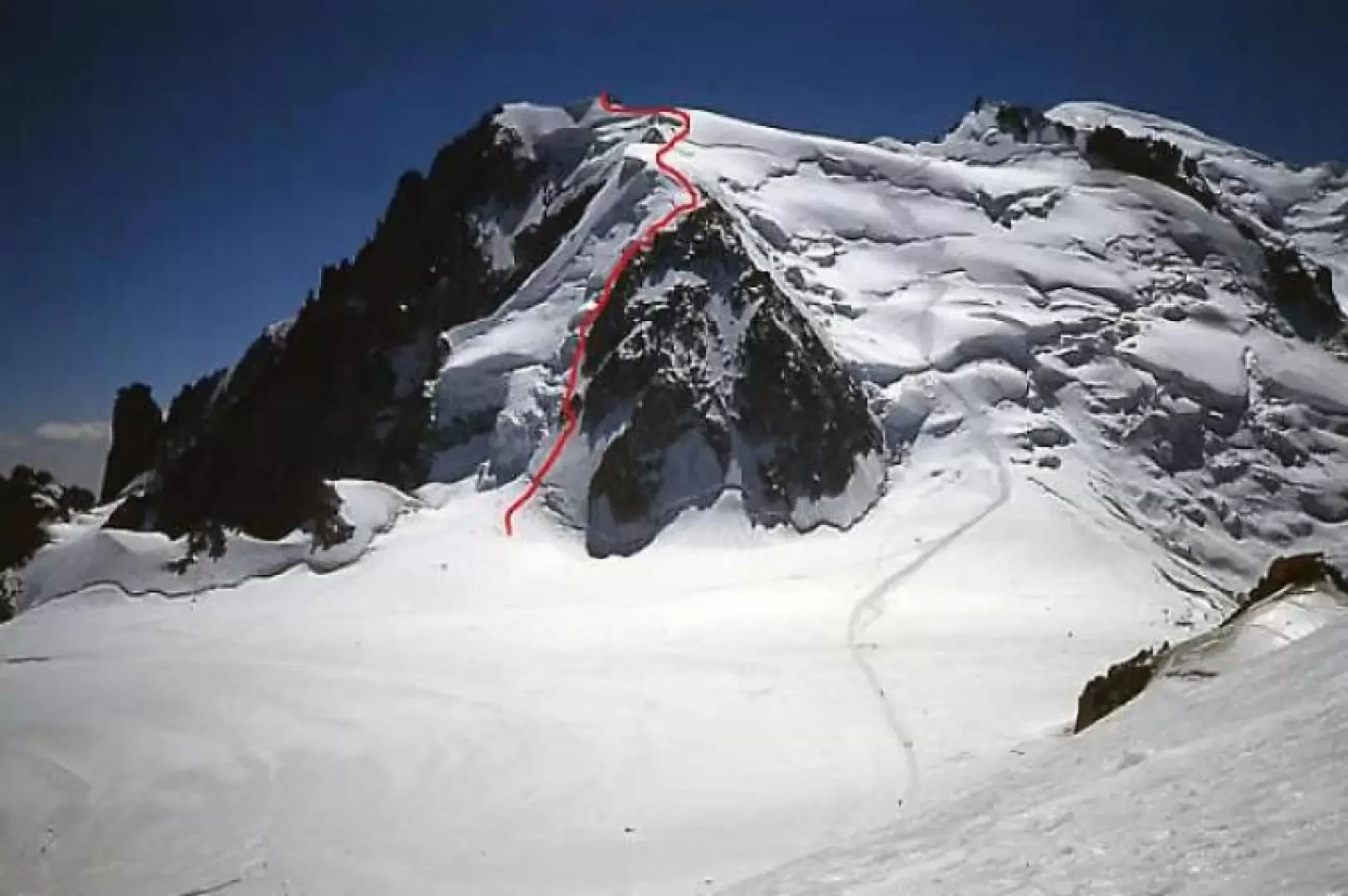
" from Aiguille du Midi (3.795m) via Goulotte Chèré to Triangle du Tacul - D - 2 days -
" from Rifugio Torino (3,375m) to Goulotte Lafaille - D+ - 1 day -
" from Col de la Fourche (3.684m) by the south-east ridge and Aiguilles du Diable - D+ - 2 days
Winter ascent routes
The Mont Blanc du Tacul is also frequented in winter and spring conditions, in particular for the goulotte on the east slope, which keeps the ice in optimal condition during the cold months. The Goulotte Lafaille was first climbed on 12 February 1985 by Jean-Christophe Lafaille solo in winter: a feat that definitively established its status as the classic route of the massif. The Goulotte Chèré is also climbed in winter and spring, when the eastern exposure guarantees stable ice conditions.
Introduction
At 4,248 metres, Mont Blanc du Tacul is the third highest peak in the Mont Blanc massif and one of the most popular mountains for high altitude mountaineering in the Western Alps. It is located on French territory, in the municipality of Chamonix-Mont-Blanc (Haute-Savoie), along the ridge that climbs from the Aiguille du Midi towards Mont Blanc via Mont Maudit. In the SOIUSA classification, it belongs to the Graian Alps, subsection Mont Blanc Alps. The summit is characterised by a complex morphological structure: the main summit emerges from a glacial dome, while the eastern slope develops a system of rocky buttresses - the pillars and spires of the Aiguilles du Diable, the Grand Capucin, the Trident - that constitute one of the richest and most frequented mountaineering sectors of the entire massif. The term Tacul, of uncertain origin, appears on historical maps of the area and originally designated the entire glacial region between the Aiguille du Midi and the Mont Blanc ridge. The first official ascent of the summit was carried out on 8 August 1855 by Charles Hudson, an English mountaineer, with Edward John Stevenson, Christopher and James Grenville Smith, E. S. Kennedy, Charles Ainslie and G. C. Joad, without the help of professional guides - an uncommon feature at the time. However, it is likely that Courmayeur guides had already reached the summit during explorations in 1854 and 1855 aimed at opening a new Italian route to Mont Blanc. Mont Blanc du Tacul is the first of the three mountains that make up the Trois Monts route, a historic itinerary opened on 13 August 1863 by R. W. Head with the guides Julien Grange, Adolphe Orset and Jean-Marie Perrod: the same team that made the first ascent of Mont Blanc from the Italian side.
.Description
Geology and morphology
The Mont Blanc du Tacul is built on the same granite base that characterises the entire Mont Blanc massif. The morphological complexity of the summit derives from the coexistence of two distinct environments: the north-west slope, dominated by ice and snow with steep slopes up to 45°, and the east slope, where the granite emerges in a series of buttresses, pillars and spires of exceptional quality. The Aiguilles du Diable - Pointe Chaubert, Pointe Carmen, Pointe Médiane, Corne du Diable, L'Isolée - form a ridge of rocky pinnacles on the eastern slope that constitutes one of the most famous technical climbing areas in the Alps. The Grand Capucin, a compact granite pillar some 350m high rising at the foot of the eastern slope, is considered one of the monuments of Alpine climbing of the second half of the 20th century. The Col du Midi (3,532m), the pass that separates the Tacul from the Aiguille du Midi, is the junction point between the Vallée Blanche and the north side of the peak.
Mountaineering History
The mountaineering history of Mont Blanc du Tacul is among the richest in the entire Mont Blanc massif. After the first official ascent by Hudson and his companions in 1855 and the subsequent ascents linked to the conquest of routes on Mont Blanc, the mountain became an avant-garde laboratory for ice and mixed techniques during the 20th century. In 1930, Renato Chabod and Gabriele Boccalatte opened the Couloir du Diable, a route that marked a turning point in ice mountaineering at the time. In 1934, Giusto Gervasutti and Chabod himself traced the Couloir Gervasutti, which bears the name of the great mountaineer from Turin and remains a reference climb on the north-east face. In 1936, Boccalatte opened the north-east pillar that today bears his name, one of the most beautiful routes on the east face. The east face attracted mountaineers of every generation in the following decades: the Contamine-Mazeaud route in 1963, the Goulotte Albinoni-Gabarrou in 1974, the Supercouloir by Gabarrou and Boivin in 1975, and the Goulotte Modica-Noury in 1979 progressively enriched a repertoire of mixed routes that is among the most complete in the Alps. In February 1985, Jean-Christophe Lafaille opened the goulotte that bears his name solo in winter, setting a technical standard that remained a reference for years. The North Face has concentrated the most serious objective dangers over the decades: the avalanche of 16 July 1974 that swept away eight French mountaineers, and the avalanche of 24 August 2008 that caused eight deaths among German, Austrian and Swiss mountaineers, have made this slope one of the most discussed in terms of objective risk assessment in the high mountains.
Cultural context
The Mont Blanc du Tacul occupies a specific place in the history of Italian mountaineering: it is one of the three summits of the Trois Monts route, the itinerary with which in 1863 the Courmayeur guides - Grange, Orset and Perrod - took the Englishman R. W. Head to the summit of Mont Blanc for the first time from the Italian side. The east side of the summit is associated with the figure of Gabriele Boccalatte, a mountaineer from Turin who opened some of the most significant routes of his career there during the 1930s. Boccalatte died in 1938 on the south face of the Aiguille de Triolet, leaving unfinished a mountaineering work of great quality; a refuge on the Grandes Jorasses bears his name and that of his companion Mario Piolti.
Traverses
" Traversing Mont Blanc du Tacul - Mont Maudit - Mont Blanc (Trois Monts route) with descent via the Goûter Refuge or the Gonella Refuge (report not present on inalto.org as a complete itinerary)
Supports
" Refuge des Cosmiques (3,616m) - French side, main base for the normal route
" Refuge Torino (3,375m) - Italian side, reachable by the Mont Blanc Skyway
Information
Height: 4.248m
Mountain group: Mont Blanc Alps
Alpine chain: Graian Alps (SOIUSA)
Typology: glacial summit with rocky east slope
Protected area: none
First ascent: 8 August 1855
First ascenders: Charles Hudson, Edward John Stevenson, Christopher Grenville Smith, James Grenville Smith, E. S. Kennedy, Charles Ainslie, G. C. Joad (without guides)
Summit book: [to be verified]
Commune(s): Chamonix-Mont-Blanc (Haute Savoie, FR)
Vallée(s): Vallée Blanche (FR); SO slope towards Col du Midi
Mountaineering difficulty: PD (normal route); D-D+ (goulotte and couloir of the east slope); D+ (Aiguilles du Diable ridge)
Average height difference: 700-900m depending on route and starting point
Recommended period: June - September (normal route); November - April (winter goulotte)
Prevalent exposure: NW (normal route); E (goulotte slope)
Presence of glaciers: yes
Presence of equipped sections: no
Collections
Chamonix-Mont-Blanc slopes | list - map
vettes of the Mont Blanc Alps | list - map