Jovençan

Edited by:
Massimo Martini
Access
Jovençan is easily accessible due to its proximity to Aosta. The motorway (Turin-Aosta) has the Aosta Ovest exit just a few kilometres away. The nearest railway station is Aosta, served by regional connections, while the reference airports are Turin-Caselle and Milan-Malpensa. The network of local roads and the proximity to the state road guarantee quick connections with neighbouring municipalities.
.Introduction
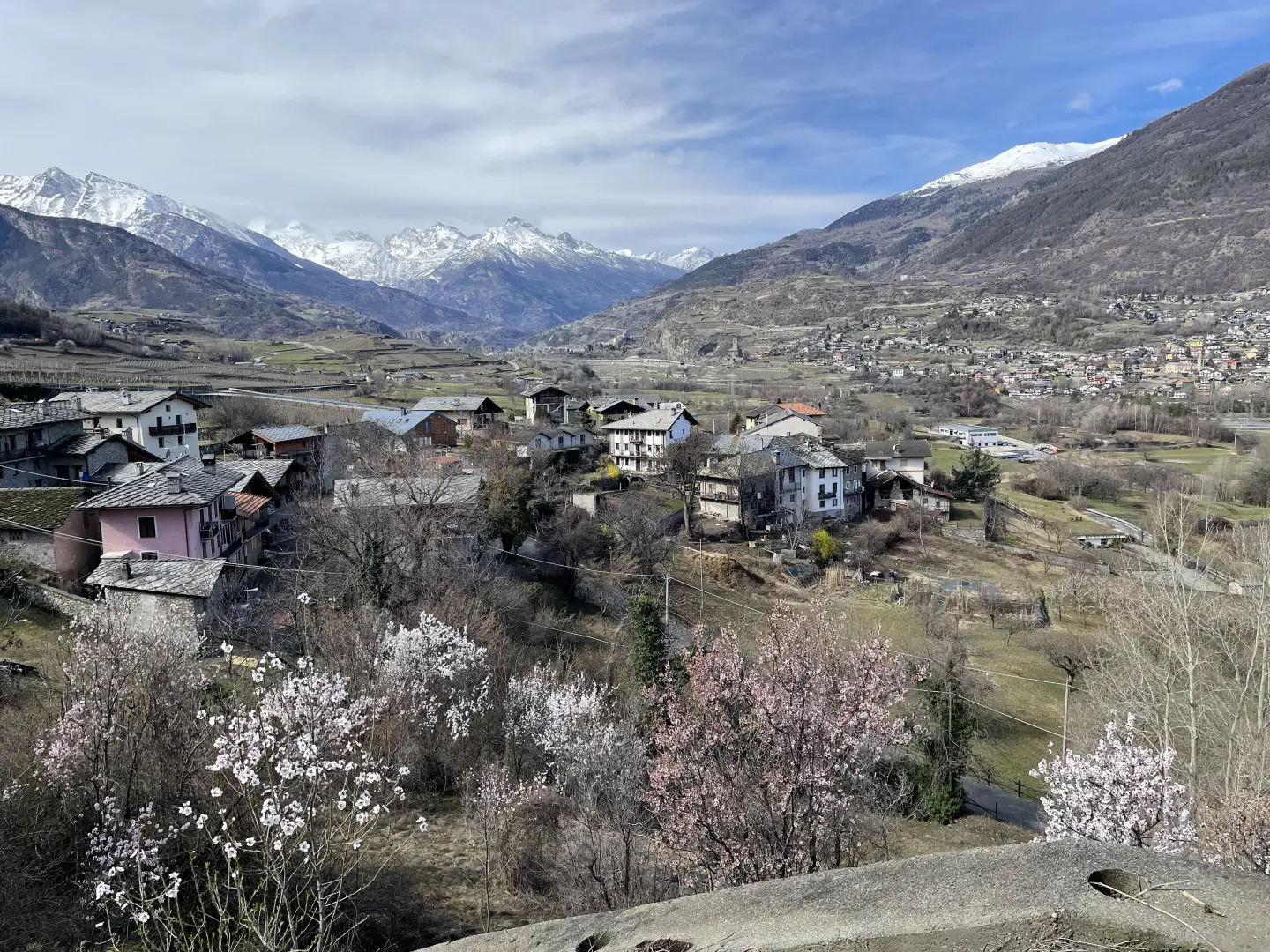
Jovençan is a small municipality in Valle d'Aosta, located on the right side of the Dora Baltea river, in a flat area of alluvial origin. Its strategic position, a short distance from the capital Aosta, makes it today a residential centre appreciated for its tranquillity and proximity to city services. Although it is a small town, it retains a deep bond with its rural origins and a history rooted in Roman times, intertwined with legends linked to the Salassi and medieval events.
Description
The name Jovençan is said to derive from the Latin Fundus Juventianus, indicating an ancient agricultural estate owned by a certain Juventius. The main nucleus of the settlement would have developed around the manor house located in the present-day village of Les Adams, site of the parish church. A local legend has it that Cordelia, the mythical capital of the Salassi people, who were annihilated by the legions of Augustus, once stood in this area; however, neither historical research nor archaeology has ever confirmed the existence of the city or a hypothetical 'ethnic cleansing' against the Salassi.
During the Middle Ages, the seigniory of Jovençan was disputed between the local lords and the House of Savoy: it was the latter who prevailed, later entrusting the feud to the powerful Challant family of Fénis. In the following centuries, the village maintained a strong agricultural vocation, specialising in fruit-growing and viticulture. These sectors are still present today, but in recent decades the social fabric has evolved: the proximity to Aosta has favoured the development of a residential area for those who wish to live in a quieter context, far from the traffic and urban rhythm of the capital.
The municipal territory, although lacking great altitudes, offers characteristic rural views, with cultivated fields, terraced vineyards and views of the surrounding mountains.
The cultural traditions are alive, especially thanks to the popular festivals. The most important is that of St George, the patron saint of the village, celebrated on 23 April with a solemn mass, procession and convivial moments involving the entire community. During the summer, events such as the Polenta Festival attract visitors from neighbouring municipalities, offering typical dishes and traditional music. An event linked to rural roots is the Vendemmia Festival, in autumn, with tastings of local wines and products.
The cuisine of Jovençan reflects that of the Aosta Valley, with a focus on zero-kilometre products. Specialities include seupa à la vapelenentse (bread, fontina cheese and Savoy cabbage soup), cheese fondue, cured meats such as boudin and jambon de Bosses, and the wines of the Vallée d'Aoste DOC, particularly those produced in the sunny vineyards surrounding the village.
From a tourist point of view, Jovençan is a convenient starting point for excursions in the lower and middle valleys, as well as a strategic base for visiting Aosta and the surrounding mountain resorts. The cycle paths along the Dora Baltea river and the routes through the vineyards offer pleasant itineraries for those who love to move on foot or by bicycle.
Information
Area:
Altitude:
Maximum elevation:
Number of inhabitants:
Name in dialect:
Inhabitants' name:
Patron Saint:
Internet Site:
Webcam:
Bordering Municipalities:
Villages and Hamlets:
Locations: