Everest

Edited by:
Massimo Martini
Access
Summit routes
Everest can be reached from two main sides, each with its own logistics and permit system: the Nepalese side, which offers the normal route to the south-east ridge, and the Tibetan (Chinese) side, which leads to the north-east ridge. Both routes develop entirely at high altitude and require progression by camps - typically four in addition to the base camp - with acclimatisation stops lasting a total of six to eight weeks. The most critical phase on the Nepalese side is the overcoming of the Khumbu glacier seracade, which is exposed to crevasses and serac collapses. On the north side, the most technically demanding section is the rocky steps of the north-east ridge, the First, Second and Third Steps, where the use of fixed ropes is well established. Both normal routes are on mountaineering difficulties of PD grade, but the extreme altitude, low oxygen concentration above 8,000m and weather conditions make each ascent a feat of exceptional magnitude.
Summer ascent routes
" from South Base Camp (5,364m), via Khumbu Glacier and South Col - PD - 6-8 weeks (including acclimatisation) - (3.485mD+) (normal route, Nepalese side)
" from Base Camp North (5,200m), via North Col and Northeast Ridge - PD+ - 6-8 weeks (acclimatisation included) - (3.649mD+) (Tibetan side)
" south-west face, British route (1975) - ED - technical ascent on mixed terrain
" east face (Kangshung), American route (1983) - ED - high difficulty route on mixed terrain and ice
Introduction
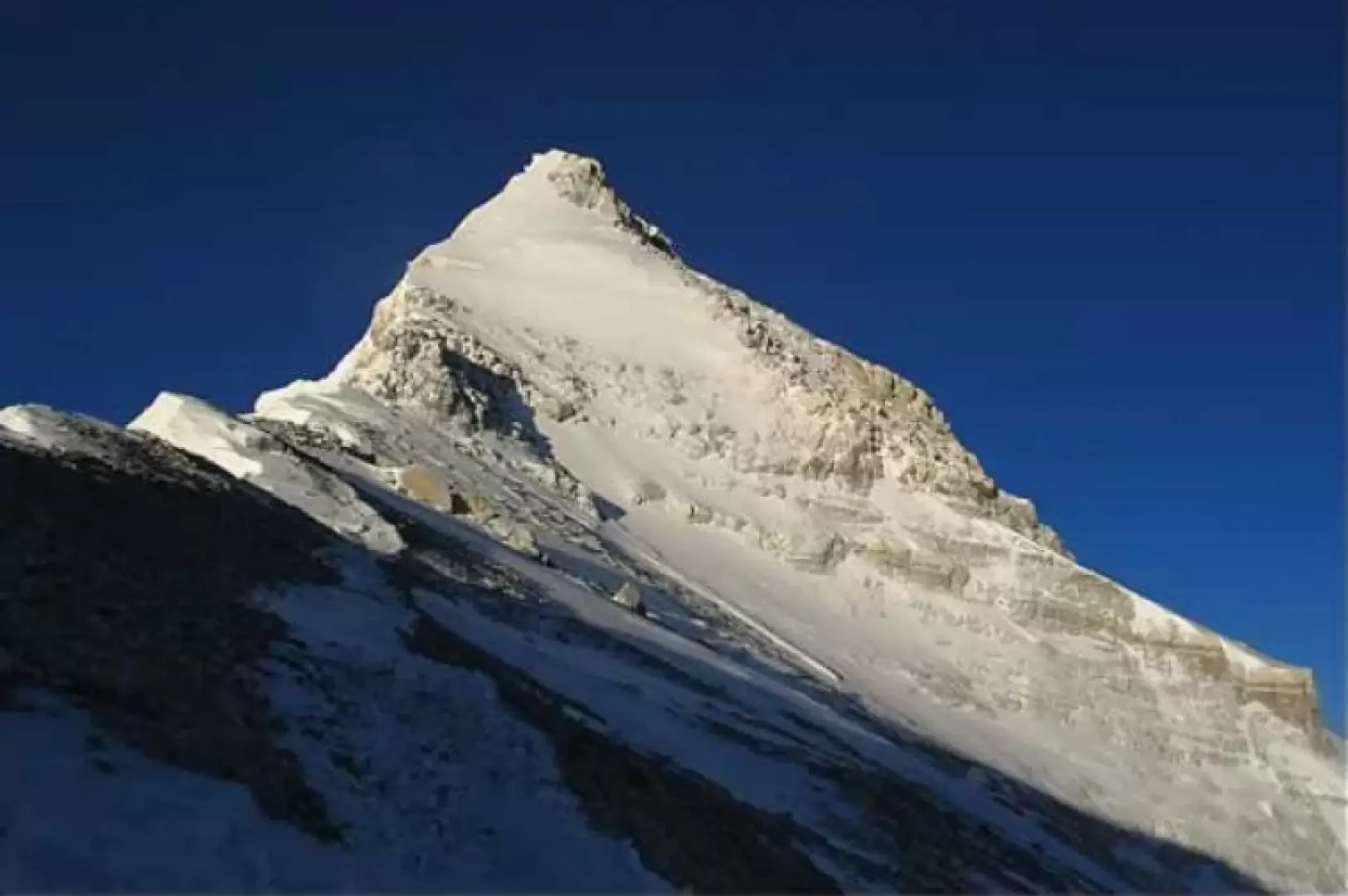
At 8,849 metres above sea level, Everest is the highest peak on earth. It rises on the border between Nepal and Tibet (China) in the central section of the Himalayan range, at the crossroads of the Solukhumbu district in the south and the Shigatse Prefecture in the north. Its shape is that of a tripartite pyramid, with three main walls - north, east and south-west - separated by as many ridges, of which the south-east and north-east are the two historical ascension corridors. The name by which the mountain is universally known was introduced in 1865 by the British topographer Andrew Waugh in honour of his predecessor Sir George Everest, who was responsible for the Great Trigonometric Survey of India; the Tibetan name Chomolungma, "mother of the universe" and the Nepalese name Sagarmatha, "god of the sky" remain the most ingrained names among the local populations. The peak was already known as "Peak XV" since 1852, when mathematician Radhanath Sikdar, processing data from the Survey of India, first identified it as the highest on Earth. The first ascent was made on 29 May 1953 by New Zealander Edmund Hillary and Sherpa Tenzing Norgay, as part of the British expedition led by Colonel John Hunt; the success was announced to coincide with the coronation of Queen Elizabeth II, and immediately became an event of global historic significance. In 1978 Reinhold Messner and Peter Habeler made the first ascent without supplementary oxygen, and in 1980 Messner returned to the summit alone, on a new route on the north face, still without oxygen: two of the most significant mountaineering feats of the 20th century.
Description
Geographical Background
Everest occupies the central position in the set of the highest peaks on the planet. On the Nepalese side it overlooks the Khumbu glacier, which descends towards the Khumbu valley to the village of Namche Bazaar, the main trading centre of the Sherpa region. The border between Nepal and China runs along the west and south-east ridges: only the south-west face is therefore entirely Nepalese, while the north and east faces fall within the Chinese territory of Tibet. To the west, the Lho La Pass (6,026m) connects it to the Khumbutse (6,636m); to the east, the South Col (7,906m) separates it from Lhotse (8,516m), the fourth highest peak on Earth; to the north, the North Col (7,066m) connects it to Changtse (7,543m). The three glaciers draining the mountain slopes - the Khumbu to the south-west, the Rongbuk to the north and the Kangshung to the east - belong to the third largest ice deposit on the planet, the Himalayan-Tibetan system, which has some 15,000 glaciers.
Geologically speaking, the structure of Everest reflects the orogenetic history of the entire Himalayan chain, produced by the collision between the Indian and Eurasian plates that started about 50 million years ago and is still ongoing. The summit and the upper slopes, above about 8,600m, consist of the Qomolangma Formation, a metamorphic limestone of marine origin from the Palaeozoic, evidence of the ancient Tethys Ocean floor. Between 7,000m and 8,600m, the Everest Formation emerges, composed of marbles, phyllites and semiscists. Below 7,000m lies the Rongbuk Formation, with schists, gneisses and leucogranitic intrusions. The three formations are separated by low-slope faults of regional importance, called "Qomolangma detachment" and "Lhotse detachment" through which the various rock strata overlap to build the chain. The still-active tectonic growth causes the summit to rise by several millimetres each year, to an extent that also depends on the earthquakes that periodically affect the region: the 2015 earthquake changed the morphology of some sections of the ridge, including the Hillary Step, transformed from a vertical rock face into a snowy ramp.
The fauna and flora, at the foot of the mountain in Sagarmatha National Park, include iconic Himalayan species such as the snow leopard (Panthera uncia), musk deer (Moschus chrysogaster), wild yak (Bos mutus) and red panda (Ailurus fulgens). The park is home to 118 species of birds and 26 species of butterflies. The vegetation varies from rhododendron, birch and juniper forests to alpine grasslands, lichens and mosses up to about 5,750 metres, the limit of permanent snow cover.
Mountaineering history
The first reconnaissance expeditions on Everest date back to the 1921 British exploration expedition led by Colonel Charles Howard-Bury, who identified the north face as the main access corridor. The following year, in 1922, the second British expedition attempted the summit for the first time: George Finch and Geoffrey Bruce reached 8,321m thanks to the pioneering use of supplementary oxygen, but the expedition was saddened by the death of seven Sherpa porters in an avalanche. 1924 marked a legendary and unresolved stage: George Mallory and Andrew Irvine disappeared on 8 June during their last attempt to attack the summit, last seen by Noel Odell less than 300 metres from the summit. Mallory's body was found in 1999 at an altitude of 8,290m, but the camera that could have witnessed the summit was not found on him or where Irvine's body is presumed to still lie: the question remains open.
In the following decades the mountain remained inaccessible from Nepal for political reasons, and attempts concentrated on the northern slope, then British territory. After World War II, Nepal opened its borders to foreign expeditions. In 1952, the Swiss expedition led by Edouard Wyss-Dunant took Tenzing Norgay and Raymond Lambert to 8,595m up the south-east ridge, about 250 metres from the summit, before being stopped by the exhaustion of forces and oxygen supplies. Success came the following year: on 29 May 1953, at 11.30 a.m., Edmund Hillary and Tenzing Norgay reached the summit via the south-east ridge, staying about fifteen minutes. The expedition was organised down to the last detail by the Joint Himalayan Committee and financed for political reasons: the United Kingdom wanted the feat to coincide with the coronation of Elizabeth II, which took place on the same day. Hillary and Norgay took photographs, buried some sweets and planted a small cross in the snow. Returning to the valley, Hillary said to George Lowe: "We knocked the bastard off."
In the years that followed, ascents, national firsts and new routes multiplied. In 1960, a Chinese expedition led mountaineers to the summit on the north face for the first time. In 1963, the Americans Tom Hornbein and Willi Unsoeld made the first traverse of Everest, ascending via the Hornbein couloir on the west ridge and descending via the south-east ridge, one of the most significant mountaineering feats of the decade. In 1973, the great Italian expedition led by Guido Monzino - 55 soldiers, 8 civilians, 110 tonnes of material - took Mirko Minuzzo and Rinaldo Carrel to the summit on 5 May, and three more Italian mountaineers on 7 May. In 1975, the British expedition opened a route on the difficult south-west face. In the same year, a Chinese expedition confirmed the altitude of 8,848m, and a Japanese climber, Junko Tabei, became the first woman on the summit.
The most radical ethical breakthrough came on 8 May 1978, when Reinhold Messner and Peter Habeler made the first ascent without supplementary oxygen, proving that survival in the extreme death zone was possible without artificial support - an achievement that high-altitude medicine had deemed impossible. Two years later, between 18 and 20 August 1980, Messner returned to the summit from the north face, alone, with a variant connecting the north ridge to the Norton couloir: the first ever solo ascent of Everest, still without oxygen. The first winter ascent was made on 17 February 1980 by the Poles Krzysztof Wielicki and Leszek Cichy, as part of an expedition led by Andrzej Zawada: Everest thus became the first eight-thousand metre peak to be climbed in the winter season.
Since the 1990s, the phenomenon of commercial expeditions has radically changed the approach to the mountain. In 1996, a blizzard during a ridge jam cost the lives of eight mountaineers, an episode narrated in the bestseller Into Thin Air by Jon Krakauer. In 2019, new queues near the summit caused further fatalities. The fatality rate, estimated at around one in forty attempts in recent seasons, remains among the highest of the eight-thousanders. More than 6,000 mountaineers had reached the summit by the end of 2024, many more than once: the record for ascents is held in a tie by Apa Sherpa and Phurba Tashi, with twenty-one ascents each.
Cultural context
For the Sherpa people of the Khumbu, the mountain has always been a place of profound spiritual significance: Chomolungma, "mother of the universe", is not simply a peak to be reached, but a sacred presence with which to have a respectful relationship. Traditional expeditions still begin with the puja, a blessing ceremony officiated by a Buddhist lama at base camp, during which they ask the mountain for protection for the expedition members and porters. The same tradition has it that many mountaineers stop one metre below the summit out of respect for the home of the gods. The history of the Sherpa porters is inextricably intertwined with that of mountaineering on Everest: without their contribution - transport, opening of camps, management of the fixed ropes, rescue - none of the great feats of the 20th century would have been possible. Tenzing Norgay, Sherpa of the Khumbu, was described by columnist Pete Boardman as "the first Asian of humble origins to achieve international fame and notoriety". After his first ascent, Edmund Hillary devoted much of his life to founding the Himalayan Trust, which financed the construction of schools, hospitals and bridges for Sherpa communities.
Fruition and attendance
Everest is the most frequented of the eight-thousanders. The climbing permit issued by the Nepalese government costs $11,000 per mountaineer in the spring season, the main climbing window (April-May). The Chinese government restricts access from the north side to authorised groups through specialised agencies. The autumn season (September-October) offers a second, less busy window. The crowding of standard routes, the massive presence of waste and the ethical issue of commercial expeditions are open debates in the international mountaineering community. The Sagarmatha National Park, established in 1976 and recognised as a UNESCO heritage site in 1979, protects the entire ecosystem around the mountain, including the Sherpa villages of Namche Bazaar and Tengboche.
Traverses
" Everest-Lhotse traverse (documented combination)
Hosts
" Khumbu Lodge - South Base Camp (5,364m) (seasonal base camp, )
" Pyramid International Laboratory and Observatory (5,050m) - Italian research station on the Nepalese side
Information
Quote: 8.849m
Alternative name: Sagarmatha (नेपाली), Chomolungma (བོད་སྐད), Peak XV (historical)
Mountain group: Central Himalaya
Alpine chain: Himalayas
Typology: rock pyramid/main summit
Protected area: Sagarmatha National Park (Nepal) / UNESCO World Heritage Site
First ascent: 29 May 1953
First climbers: Edmund Hillary, Tenzing Norgay
First winter ascent: 17 February 1980
First ascenders in winter: Krzysztof Wielicki, Leszek Cichy
Vice book: absent
Commune/s: Solukhumbu (Nepal) / Shigatse (Tibet, China)
Valley(s): Khumbu Valley (S), Rongbuk (N)
Mountaineering difficulty: PD (normal routes); ED (walls)
Average elevation gain: 3.485m (from Base Camp South)
Recommended period: April-May; September-October
Prevalent exposure: S-W (Nepalese side); N (Tibetan side)
Presence of glaciers: yes (Khumbu, Rongbuk, Kangshung)
Presence of equipped sections: yes (fixed ropes on both normal routes)
Collections
country high point - list - map