Dent d'Herens

Edited by:
Massimo Martini
Access
Introduction
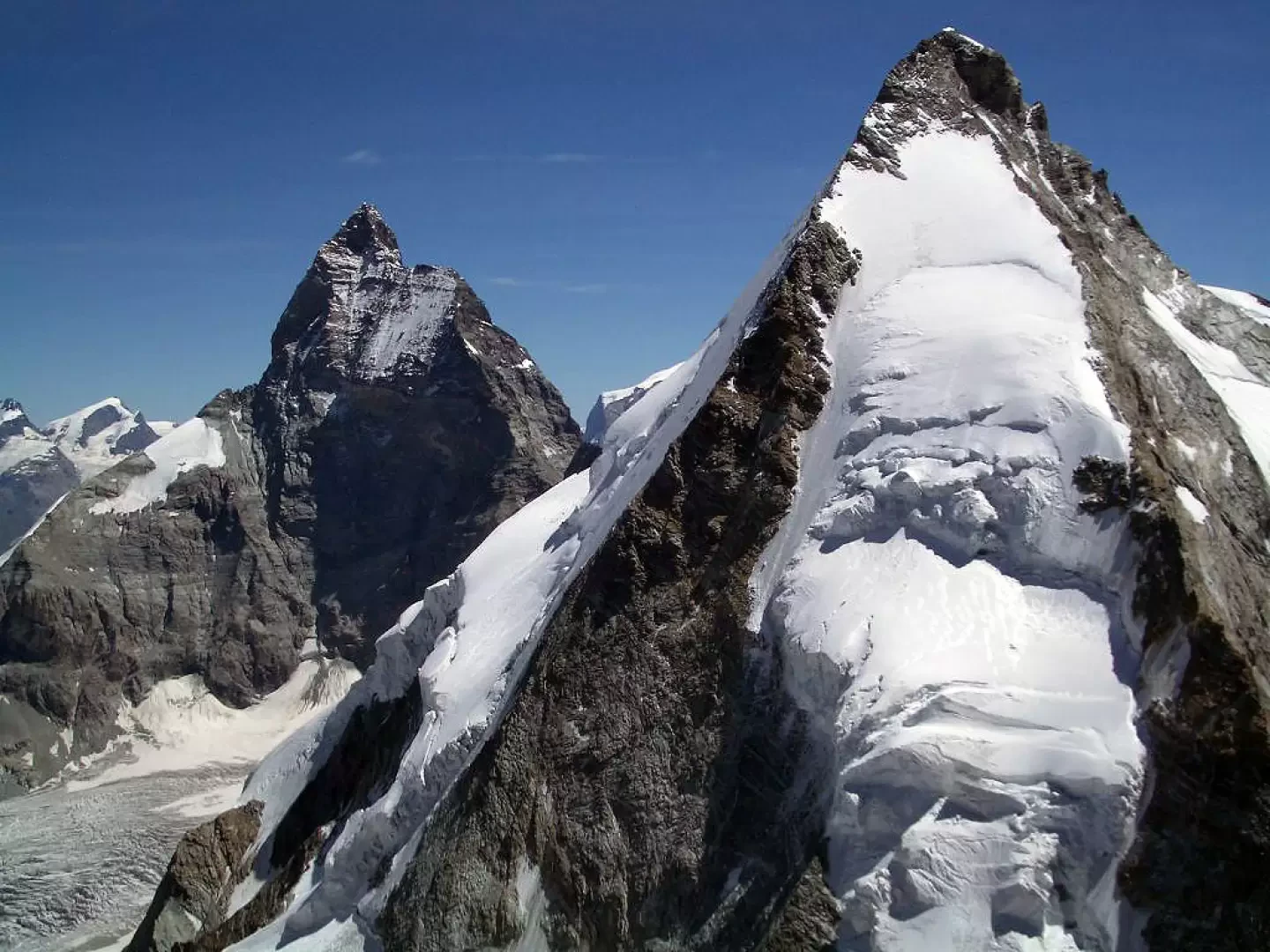
A stunning 4,000-metre peak, unjustly overshadowed by the presence of its taller neighbour, the Gran Becca, just a short distance away; in my opinion, the only thing it has to envy is the Gran Becca’s extra height of almost three hundred metres: the Dent d’Hérens is practically invisible in all its splendour from any town in the Aosta Valley. Not even from Breuil-Cervinia is the eye drawn to this mountain, linked to the Matterhorn by a magnificent and challenging ridge.
Description
The Swiss north face is a completely different matter, with a staggering vertical drop of over 1,000 metres; and the view you can enjoy from the western side as you climb to the nearby Tête de Valpelline. It is indeed the Italian side that offers the easiest ascent route, though certainly not the safest: the normal route runs along the south face after a long approach across a very rugged glacier, and climbs steep slopes that are absolutely to be avoided during the hottest parts of the day and in seasons when they are not covered in snow. The ascent of the splendid west ridge is a completely different matter; it is not excessively difficult but never straightforward: safe, with good rock, always airy and exposed, and thrilling in places, especially when climbed with crampons when covered in snow. Don’t hesitate to tackle it on the descent as an alternative to the dangerous standard route!! A magnificent 4,000-metre peak, unjustly overshadowed by the presence of its bigger sister, the Gran Becca, so close by; in my opinion, the only thing it has to envy is the Gran Becca’s extra height of almost three hundred metres. The Dent d’Hérens is practically invisible in all its splendour from any town in the Aosta Valley. Not even from Breuil-Cervinia is one’s gaze drawn to this mountain, linked to the Matterhorn by a magnificent and challenging ridge. The Swiss north face is quite another matter altogether, with its impressive vertical drop of over 1,000 metres; and the view one can enjoy of the west face whilst ascending to the nearby Tête de Valpelline. It is indeed the Italian side that offers the easiest ascent route, though certainly not the safest: the standard route runs along the south face after a long approach across a very rugged glacier, and climbs steep slopes that should absolutely be avoided during the hottest part of the day and in seasons when they are not covered in snow. The ascent of the splendid west ridge is a completely different matter: not excessively difficult but never straightforward. It is safe, with good rock, consistently airy and exposed, and in some sections truly thrilling, especially when tackled with crampons when covered in snow. Don’t hesitate to tackle it on the descent as well, as an alternative to the dangerous standard route!!
Information
Altitude: 4,175 m
Alternative name: -
Mountain range:
First ascent:
First ascenders:
First winter ascent:
First winter ascenders: