
Edited by:
Massimo Martini
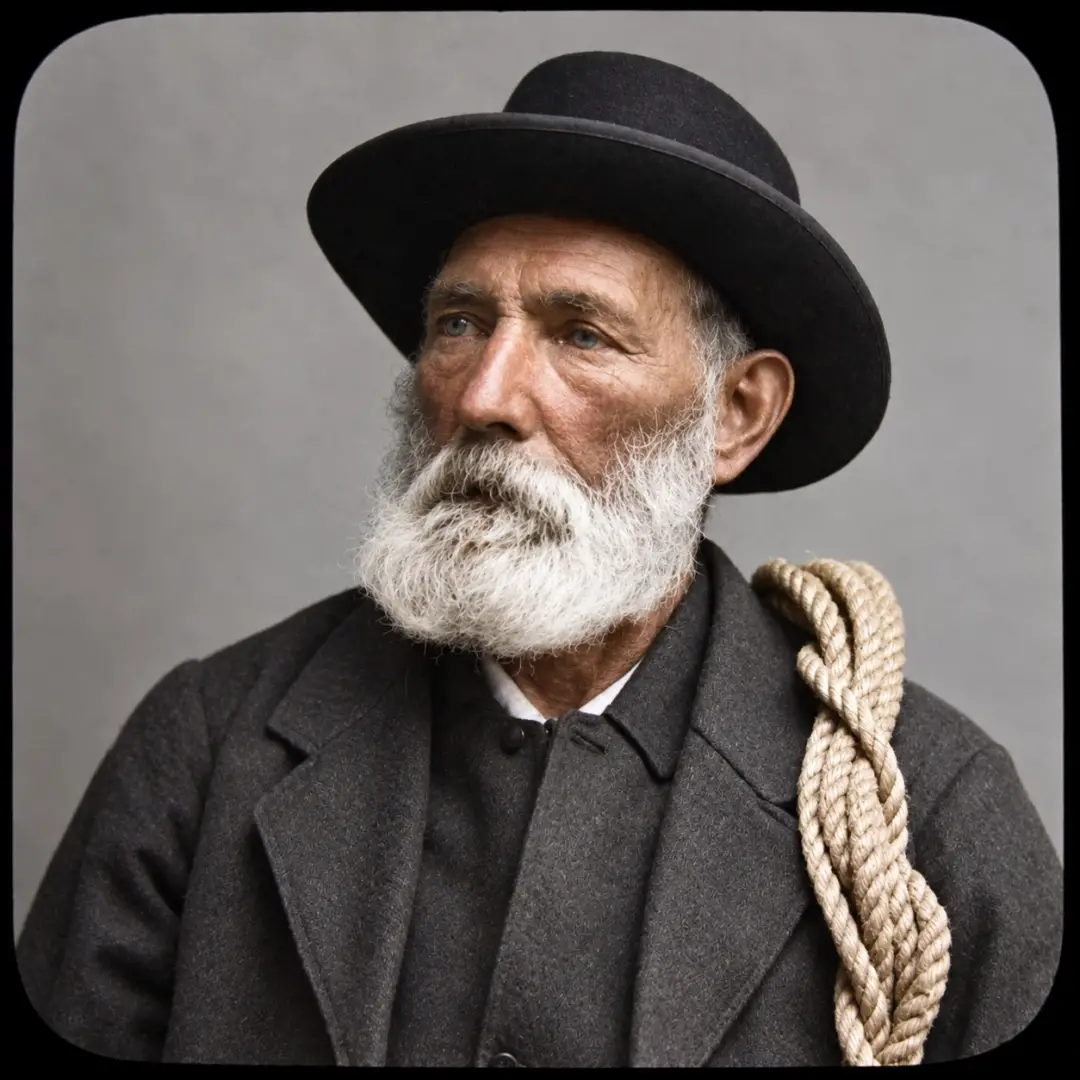
A mountain guide from Grindelwald, who led the first ascent of the Eiger in 1858.
Personal details
Name: Christian Almer
Date of birth: 29 March 1826 – Grindelwald
Date of death: 17 May 1898 – Grindelwald
Nationality: Swiss
Occupation: mountain guide
Biography
Christian Almer was born on 29 March 1826 in Grindelwald, in theBernese Oberland, the eldest of the children born from Ulrich Almer’s second marriage. As a boy and young man, he tended goats and sheep on the Gletscheralp, the pasture known as Zäsenberg at the foot of the lower Grindelwald Glacier, and in the summers when cheese-making on the alpine pastures left him time, he devoted himself to hunting chamois. His work as a herdsman, which required him to search for stray livestock amongst the rocks and ice, and his hunting activities accustomed him to the high mountains long before the profession of mountain guide existed. On 6 June 1846, he married Margaritha Kaufmann and, in 1847, during the Sonderbund War, he took part as a soldier in the Second Company of Hunters in the advance on Lucerne.
The years leading up to his entry into the profession remain partly obscure. A crossing of the Strahlegg in 1843 and an attempt on the Wetterhorn in 1845 may have involved him, but the sources do not allow us to attribute them to him with certainty. His first documented assignment as a guide dates back to September 1851. In Grindelwald, the profession was not formally organised until 1856: on 12 May, the Government of the Canton of Bern approved the regulations for guides and porters, and on 4 July, Almer received one of the first authorised guide licences, number 78. He kept it carefully throughout his career. Together with a second licence, issued on 6 May 1891, it forms the documentary basis for his ascents, as only three or four expeditions appear to be unrecorded. In 1896, a facsimile edition was published in London without his permission.
The Wetterhorn, which overlooks Grindelwald, remained his favourite mountain: he first climbed it in 1854, from Grindelwald, and made his final ascent there in 1897. His reputation as a reliable guide was forged in the field. In 1856, Porges of Vienna, who had seen him lead a descent in fog, chose him as his chief guide; on the Aletsch Glacier – which Almer claimed never to have traversed – he rescued him from a crevasse into which he had fallen. In 1861, he led H. B. George up Mont Blanc without following any previous routes, even though neither of the two guides had ever climbed the mountain before, much to the dismay of the Bureau des Guides in Chamonix. Through George, he met A. W. Moore and, via him, a circle of British mountaineers who hired him for years. In June and July 1865, he accompanied Edward Whymper for almost four weeks – the only season he spent with him; he left him on 7 July as he was already committed elsewhere and was therefore not present for the ascent of the Matterhorn on 14 July. In the same year, he brought back a dog, Tschingel, from the Lötschental, which he gave as a gift in July 1868 to William Augustus Brevoort Coolidge, then aged seventeen, to console him after a failed attempt on the Eiger.
From 1868 to 1884, Almer travelled every summer with Coolidge, for one to three months, in the Western Alps and parts of the Central Alps, accompanied until 1875 by Coolidge’s aunt, Meta Brevoort. In 1875, during an attempt on the Aiguille Verte, he was forced to turn back some thirty metres from the summit because a slope of fresh snow was resting on a steep slab; the slope broke away a few minutes later. On 7 January 1885, he guided an English client on a winter ascent of the Jungfrau with the intention of spending the night on the summit; the wind thwarted the plan and the party wandered across the glaciers all night. Almer suffered such severe frostbite that all the toes on his right foot had to be amputated. By 1886, he was already back on the summits of Cima di Jazzi, the Wetterhorn, the Mönch and the Eiger, and continued to climb until the age of seventy-one.
Of his children, the eldest sons died in infancy. Ulrich, the eldest surviving son (1849–1940), made his debut as a mountaineer in 1865 and became a guide in his own right; Christian, born in 1859, accompanied Coolidge from 1876 and was groomed by Almer to succeed him. At the time of his death, he had five sons who were guides, three daughters – two of whom had emigrated to America – and 31 grandchildren. In June 1896, he celebrated his golden wedding anniversary with his wife by climbing the Wetterhorn with her, a peak she had never visited before. His final expedition was the crossing of the Lauteraarsattel in the autumn of 1897. He died at dawn on 17 May 1898 in Grindelwald, surrounded by his children, and was buried three days later, on the day after Ascension Day, in the village cemetery. The funeral was attended by guides from Grindelwald, Lauterbrunnen and Meiringen, as well as guests staying in the village.
Mountaineering exploits
Jungfrau – 1851 – attempt on 13 September with C. A. Baumgartner and Christian and Peter Michel, abandoned at the Rotthalsattel due to the late hour; first documented assignment as a guide
Wetterhorn – 1854 – first ascent from Grindelwald (third overall), 17 September, with Ulrich Kaufmann, following the same route and on the same day as Alfred Wills’ expedition
Rosenhorn – 1854 – second ascent overall and first from Grindelwald
Mittelhorn – 1854 – second ascent overall and first from Grindelwald, 20 August
Jungfrau – 1856 – three ascents from Grindelwald; the first, on 26 July with Robert Chapman and Peter Bohren, was the sixth ascent
Klein Schreckhorn - 1857 – first ascent and traverse, 7 August, with Eustace Anderson
Mönch - 1857 – first ascent, 15 August, with Porges
Lauteraarsattel - 1857 – first complete traverse from Grindelwald to the Grimsel, 22 August, with Captain Campbell, Porges and Stern
Eiger – 1858 – first ascent, 11 August, with Charles Barrington
Lauteraarsattel - 1859 – traverse on 2 August with Gottlieb Studer and Bucher, with Ulrich Kaufmann as second guide; the only documented joint ascent by Almer and Studer
Mont Blanc - 1861 – ascent with H. B. George and the guide Peter Perren, without following previous routes
Gross Fiescherhorn - 1862 – first ascent with H. B. George and A. W. Moore; the name Almerhorn was proposed for the summit
Sesiajoch, Jungfraujoch and Mischabeljoch - 1862 – new routes with H. B. George and A. W. Moore
Pointe des Écrins - 1864 – first ascent and first east-to-west traverse, with A. W. Moore
Brèche de la Meije - 1864 – first traverse, with A. W. Moore
Col de la Pilatte - 1864 – first traverse
Mont Blanc - 1864 – with A. W. Moore from the Pavillon Bellevue via the Aiguille du Goûter and the Dôme du Goûter to Chamonix in a single day
Moming Pass and Wetterlücke - 1864 – first crossings, with A. W. Moore (first tourist crossing via the Wetterlücke)
Schallijoch - 1864 – discovered and traversed for the first time with J. J. Hornby and T. H. Philpott
Aletschhorn - 1864 – first traverse, with J. J. Hornby and T. H. Philpott
Grand Cornier - 1865 – first ascent, with Edward Whymper
Grandes Jorasses, western summit - 1865 – first ascent, with Edward Whymper
Aiguille Verte - 1865 – first ascent, with Edward Whymper
Ruinette - 1865 – first ascent, with Edward Whymper
Dent Blanche – 1865 – third ascent, with Edward Whymper
Col du Mont Dolent and Col de Talèfre - 1865 – first traverses, with Edward Whymper
Lauterbrunner Breithorn – 1865 – with J. J. Hornby and T. H. Philpott; first ascent [to be verified]
Silberhorn – 1865 – second ascent overall and first via the north face, with J. J. Hornby and T. H. Philpott
Jungfrau - 1865 – first ascent from Wengernalp, with H. B. George
Gross Nesthorn – 1865 – first ascent, with H. B. George
Piz Bernina - 1866 – new route from Crast'agüzzasattel, with F. F. Tuckett
Punta Taviela and Monte Rosole - 1866 – first ascents, with F. F. Tuckett
Ebnefluhjoch - 1866 – first traverse, not repeated until 1898, with J. J. Hornby and T. H. Philpott
Agassizjoch - 1866 – first traverse, with J. J. Hornby and T. H. Philpott
Lyskamm - 1867 – new route via the south-west ridge, with Morshead and C. E. Mathews
Col de Béranger - 1869 – new route, with W. A. B. Coolidge and Meta Brevoort
Mont Blanc - 1869 – new descent via the Crête des Bosses, with W. A. B. Coolidge and Meta Brevoort
Meije, central summit - 1870 – first ascent, with W. A. B. Coolidge and Meta Brevoort
Ailefroide - 1870 – first ascent, with W. A. B. Coolidge
Eiger - 1871 – new route via the south-west ridge, with W. A. B. Coolidge and Meta Brevoort
Weißhorn - 1871 – first ascent from the Bies Glacier, in August with Kitson and a month later with W. A. B. Coolidge and Meta Brevoort
Matterhorn - 1871 – fourth traverse and the first completed by a woman, Meta Brevoort, with W. A. B. Coolidge
Unterbächhorn and Agassizhorn - 1872 – first ascents, with W. A. B. Coolidge and Meta Brevoort
Râteau, Montagne des Agneaux and Grande Ruine - 1873 – first ascents in the Dauphiné, with W. A. B. Coolidge and Meta Brevoort
Wetterhorn and Jungfrau – 1874 – first winter ascents, with W. A. B. Coolidge and Meta Brevoort
Mont Thuria - 1874 – first ascent and traverse
Pic de la Grave - 1874 – first ascent of the highest point
Pointe Marguerite - 1875 – first ascent; the name commemorates Meta Brevoort
Mönch - 1875 – ascent via the south-west ridge and first descent to Kleine Scheidegg, with Wethered
Grand Plateau of Mont Blanc - 1876 – first winter ascent, with W. A. B. Coolidge
Les Droites – 1876 – first ascent of the second summit, with W. A. B. Coolidge
Täschhorn - 1876 – new route from the Mischabeljoch, with James Jackson
Adamello - 1876 – first ascent from Val Miller, with W. A. B. Coolidge
Tödi - 1876 – traverse of the two peaks from the Grünhornhütte with descent via the Porta da Spescha to Disentis, with W. A. B. Coolidge
Col des Avalanches – 1877 - first traverse, not repeated until 1898
Les Bans - 1878 - first ascent, with W. A. B. Coolidge
Aiguilles d'Arves, southern summit – 1878 – first ascent, with W. A. B. Coolidge
Meije, western summit – 1878 – second ascent ever, with W. A. B. Coolidge
Punta dell’Argentera – 1879 – first ascent, with W. A. B. Coolidge
Mont Clapier – 1879 – first traverse of the north face; the westernmost point reached by Almer in the Alps
Gross Schreckhorn - 1879 – first winter ascent, with W. A. B. Coolidge
Monte Viso - 1879 – second ascent from the north-west
Visolotto – 1881 – first ascent of the highest peak, with W. A. B. Coolidge
Monte Viso - 1881 – first ascent from the north-east, not repeated until 1898
Pelvoux - 1881 – new route from the west
Pointe des Écrins - 1881 – first traverse from south to north
Ciamarella - 1883 – first traverse
Bessanese - 1883 – first ascent by foreign mountaineers
Pointe de Solliette - 1884 – first ascent and traverse
Dôme de Polset - 1884 – second ascent and first traverse from Pralognan to Modane, 31 July, final ascent with W. A. B. Coolidge
Bietschhorn - 1895 – traverse at the age of 69, with Davidson
Meije - 1896 – ascent on 19 August at the age of 70, with H. J. Heard
Wetterhorn - 1896 – ascent in June with his wife to celebrate their golden wedding anniversary, accompanied by a daughter and two sons
Wetterhorn - 1897 – final summit, in August, aged 71
Lauteraarsattel - 1897 – autumn traverse,autumn, final excursion
Bibliography
As a writer
A facsimile of Christian Almer’s Führerbuch, 1856–1894, London, 1896
As a key reference
W. A. B. Coolidge, Christian Almer, Yearbook of the Swiss Alpine Club, 1898
Peter Bernet, Almer, Christian, Historical Dictionary of Switzerland, 2001