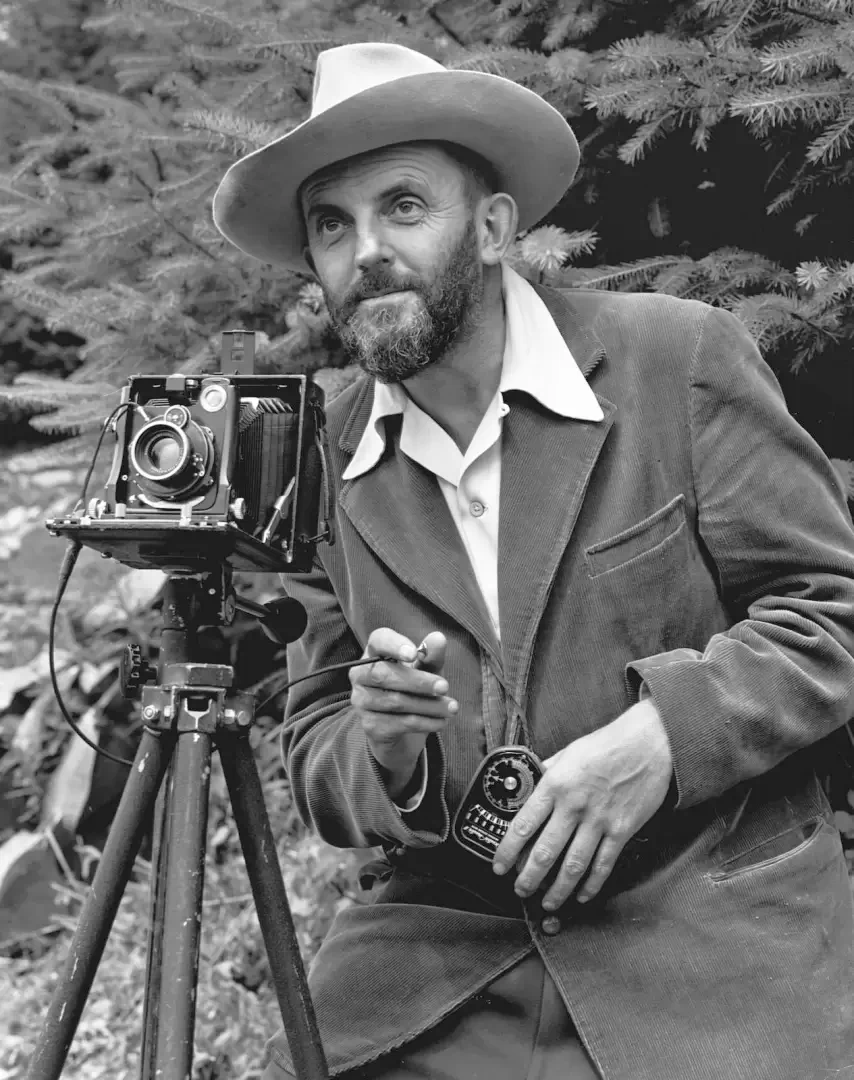

Edited by:
redazione
An American photographer and environmentalist, he documented Yosemite and the Sierra Nevada in black and white from 1916 onwards.
Personal details
Name: Ansel Easton Adams
Born: 20 February 1902 - San Francisco, California (United States)
Died: 22 April 1984 - Monterey, California (United States)
Nationality: American
Occupation: photographer, writer, lecturer
Affiliation: Sierra Club, from 1919
Biography
Ansel Easton Adams was born in San Francisco on 20 February 1902, the only child of Charles Hitchcock Adams and Olive Bray. His name is closely associated with the Sierra Nevada mountains, which he photographed from his teenage years right up until his final years, and with the Sierra Club, the organisation through which he championed the conservation of natural areas in the western United States for almost forty years.
He received a partly private education and devoted himself for many years to studying the piano, with the intention of becoming a concert pianist. In 1916, she visited Yosemite Valley for the first time during a family holiday and was given a Kodak Brownie No. 1 by her parents, with which she took her first photographs. In 1919, he joined the Sierra Club, founded in 1892 by John Muir, and from 1920 he spent four summers as caretaker of the club’s headquarters in the valley, alternating work with long hikes in the High Sierra. In 1921, whilst looking for a piano on which to practise, he met Virginia Best, daughter of the painter Harry Best, who ran a studio in the valley. The couple married in Yosemite on 2 January 1928 and had two children, Michael and Anne.
His transition from music to photography took shape in 1927. In April, from a ledge on the face opposite Half Dome, Adams photographed the north-west face of the mountain using a red filter to darken the sky: the image, entitled Monolith, the Face of Half Dome, marked for him the shift from documentary photography to a style in which he anticipated the desired effect in the print whilst taking the photograph. In the same year, he published his first portfolio and, in the years that followed, abandoned his plans for a career in music. In 1932, he was among the founders of the f/64 Group alongside Edward Weston, Imogen Cunningham and Willard Van Dyke: the name refers to one of the smallest aperture settings of theera and encapsulates the group’s ethos: sharp photography with a deep depth of field, in contrast to the pictorialist tradition. In 1936, Alfred Stieglitz organised a solo exhibition of his work in New York, and in 1940 Adams helped establish the photography department at the Museum of Modern Art. Around 1940, together with Fred Archer, he developed the Zone System, a method for adjusting exposure and negative development according to the tones intended in the final print.
In 1934, he was elected to the Sierra Club’s board of directors, where he remained until 1971. His 1938 photographic book on the Sierra along the John Muir Trail was used in the campaign to protect the Kings Canyon region, which was designated a national park in 1940. Between 1941 and 1942, he photographed national parks and monuments on behalf of the Department of the Interior. In 1943, he worked at the Manzanar camp in California, where US citizens and residents of Japanese origin were interned during the Second World War: he produced portraits and images of daily life there, which were compiled into a book the following year.
In 1975, he helped found the Centre for Creative Photography at the University of Arizona in Tucson, and in 1980 he was awarded the Presidential Medal of Freedom. In his later years, he lived in Carmel Highlands, on the coast of the Monterey Peninsula, and continued to print his own negatives right up until he was hospitalised. He died on 22 April 1984 at the Community Hospital of the Monterey Peninsula, in Monterey, where he had been hospitalised for three days due to heart problems. In the same year, the Minarets Wilderness protected area in the Sierra Nevada was renamed the Ansel Adams Wilderness. In 1985, the peak at the head of the Lyell Fork of the Merced River, on the south-eastern boundary of Yosemite National Park – which had already been informally named after him by Sierra Club mountaineers who climbed it in the 1930s – was officially named Mount Ansel Adams. The Best family’s studio in Yosemite Valley is now the Ansel Adams Gallery.
Works
Parmelian Prints of the High Sierras, San Francisco, Jean Chambers Moore, 1927
Making a Photograph, London – New York, The Studio, 1935
Sierra Nevada: The John Muir Trail, Berkeley, The Archetype Press, 1938
Born Free and Equal: The Story of Loyal Japanese-Americans, New York, U.S. Camera, 1944
This Is the American Earth, with Nancy Newhall, San Francisco, Sierra Club, 1960
The Camera, Boston, New York Graphic Society, 1980
The Negative, Boston, New York Graphic Society, 1981
The Print, Boston, New York Graphic Society, 1983
Ansel Adams: An Autobiography, with Mary Street Alinder, Boston, Little, Brown, 1985
Bibliography
As a writer
not found: no critical study specifically devoted to Adams’s written work has been identified in this review
As a photographer
To view his works www.anseladams.com
As a key reference
Nancy Newhall, Ansel Adams: The Eloquent Light, San Francisco, Sierra Club, 1963
Jonathan Spaulding, Ansel Adams and the American Landscape: A Biography, Berkeley, University of California Press, 1995
Mary Street Alinder, Ansel Adams: A Biography, New York, Henry Holt and Company, 1996