
Edited by:
redazione
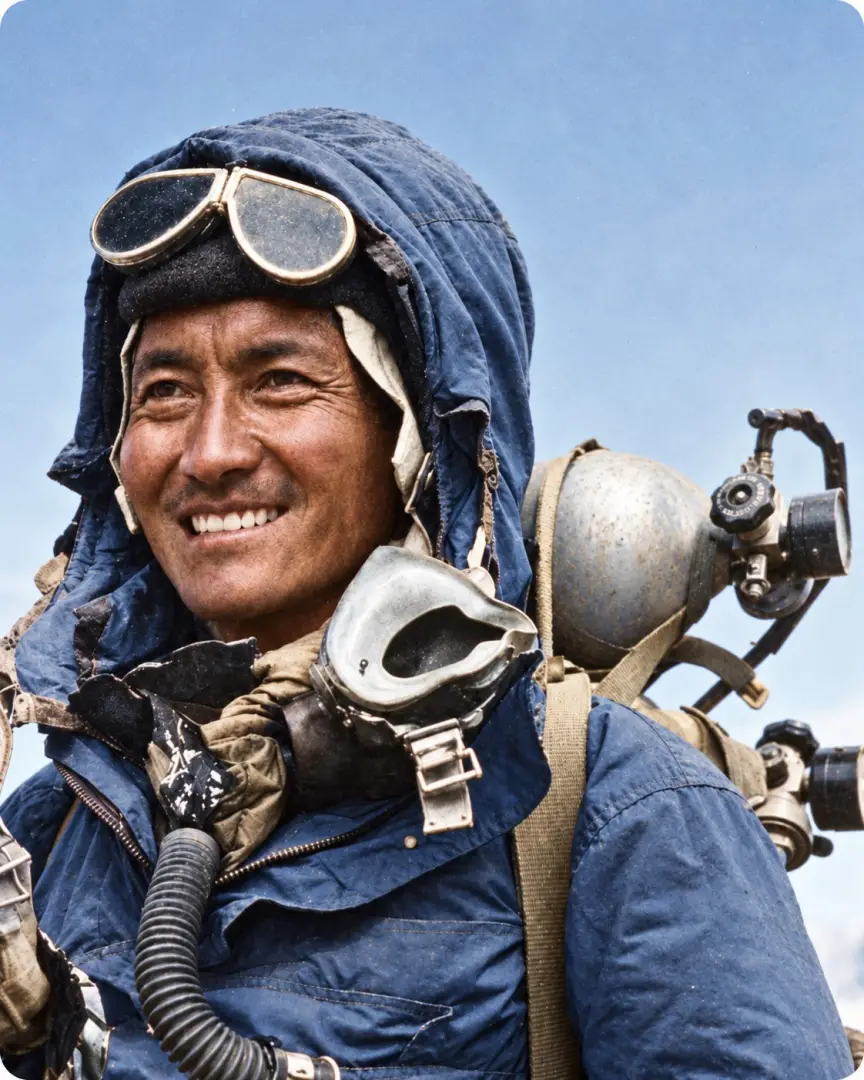
A Sherpa mountaineer, he reached the summit of Everest with Edmund Hillary on 29 May 1953.
Personal details
Name: Tenzing Norgay (born Namgyal Wangdi)
Date of birth: [May 1914] – [place not documented with certainty]
Died: 9 May 1986 – Darjeeling, West Bengal
Nationality: Nepalese-Indian
Occupation: mountaineer, Sherpa sirdar, mountaineering instructor
Affiliation: Himalayan Mountaineering Institute, Darjeeling
Biography
He was born in May 1914 as Namgyal Wangdi, into a family of small-scale farmers and mountain herders. His exact date of birth is not documented: 29 May, which coincides with the date of the ascent of Everest, is commonly accepted, whilst other sources indicate 15 May. The year 1914 is inferred from the Tibetan calendar; therefore, it is more likely than certain. The place of birth is also uncertain: the most commonly cited accounts point to Tse Chu, in the Tibetan Kama Valley, with his childhood spent in Kharta and his upbringing in Thame, in the Nepalese Khumbu region; other sources mention the Tibetan village of Moyey or, more generally, the Khumbu region. According to his biographies, the name by which he is known was given to him on the advice of the lama Ngawang Tenzin Norbu, founder of Rongbuk Monastery, and is usually translated as "fortunate and wealthy follower of the religion".
Around 1932, he settled in Darjeeling, where many Sherpas from the Khumbu region were seeking work with British expeditions. As a high-altitude porter, he was included in the expeditions toEverest in the second half of the 1930s, and in 1938 he was among the first ten Sherpas to receive the Tiger Medal, established that year by the Himalayan Club for the most deserving high-altitude porters; the medal was not presented to him until 1945. During the Second World War, he worked for Colonel White of the Chitral Militia, travelling through the Hindu Kush and the Karakoram. After the war, he established himself as a sirdar, the leader of the Sherpas on an expedition, and in 1949 he accompanied the Italian orientalist Giuseppe Tucci to Lhasa in Tibet on a research journey amongst the Tibetan monasteries.
In 1953, he joined the British expedition to Everest led by John Hunt, not only as sirdar but as a full member of the team, and on 29 May he reached the summit with Edmund Hillary: this was the first confirmed ascent of the mountain. Newspapers of the time spelled his name in various ways, from Tensing to Tenzing Bhotia and Tenzing Sherpa. Sources describe him as Nepalese, Indian or both; he lived for most of his life in Darjeeling, India, within a community of Sherpas originally from the Khumbu region. He was awarded the George Medal by the United Kingdom, the Nepal Tara by Nepal and the Padma Bhushan by India.
The Himalayan Mountaineering Institute was founded in Darjeeling in November 1954 on the initiative of Jawaharlal Nehru. Tenzing served as Director of Field Training from June 1954 to May 1976, leading a team of Sherpa instructors, and subsequently as an adviser until his death. Tradition has it that Nehru asked him to train a thousand ‘Tenzings’ through the school. During his time as director, he travelled to many countries for mountaineering events; in 1976, he was succeeded by Nawang Gombu, an instructor at the institute since its foundation. In 1978, he founded Tenzing Norgay Adventures, a Himalayan trekking company; according to other sources, this was in 1973; the business was later taken over by his son Jamling, who climbed Everest in 1996. At his home in Darjeeling, he kept a kennel of Lhasa Apsos and Tibetan Mastiffs.
He died on 9 May 1986 at his home in Darjeeling. At his funeral, the procession was followed by Bhutias, Sherpas, Gurkhas and people from other communities. At the institute in Darjeeling there is a monument dedicated to him, the Tenzing Memorial.
Mountaineering achievements
Everest (8,849 m) - 1935 – Tibet, Himalayas – British reconnaissance expedition led by Eric Shipton
Everest (8,849 m) - 1936 – Tibet, Himalayas – British expedition led by Hugh Rutledge, carrying supplies as far as the North Col
Everest (8,849 m) - 1938 – Tibet, Himalayas – British expedition led by Bill Tilman; members of the party reached 8,293 m, the expedition’s highest altitude
Everest (8,849 m) - 1947 – Tibet, Himalayas – clandestine attempt with Earl Denman and Ang Dawa, reaching the vicinity of the North Col
Garhwal (India), Himalayas – 1947 – Swiss expedition led by André Roch, who was promoted to sirdar of the Sherpas during the expedition
Bandarpunch, Garhwal (India), Himalayas – 1950 – first ascent, expedition led by Jack Gibson
East Nanda Devi, Garhwal (India), Himalayas – 1951 – ascent during the search for the two French mountaineers Duplat and Vignes
Everest (8,849 m) – 1952 - Nepal, Himalayas – Swiss expedition along the south face, with Raymond Lambert reaching over 8,500m, the highest altitude reached on the mountain at the time
Everest (8,849m) – 1953 - Nepal, Himalayas – 29 May, first confirmed ascent with Edmund Hillary, British expedition led by John Hunt, full member and sirdar of the Sherpas
Works
Man of Everest: the autobiography of Tenzing, London, George G. Harrap [to be verified], 1955 (with James Ramsey Ullman; US edition Tiger of the Snows)
After Everest: an autobiography, London, George Allen & Unwin [to be verified], 1977 (with Malcolm Barnes)
Bibliography
As a writer
no critical study of his written work found
As a key reference
John Hunt, The Ascent of Everest, London, Hodder & Stoughton?, 1953
Jamling Tenzing Norgay with Broughton Coburn, Touching My Father’s Soul, publisher?, 2001
Tashi Tenzing and Judy Tenzing, title and publisher ?, 2001
Ed Douglas, Tenzing: Hero of Everest. A Biography of Tenzing Norgay, Washington, National Geographic Society, 2003
Dorjee Lhatoo, “My Guru – Tenzing Norgay”, The Himalayan Journal, 71, 2016