
Edited by:
redazione
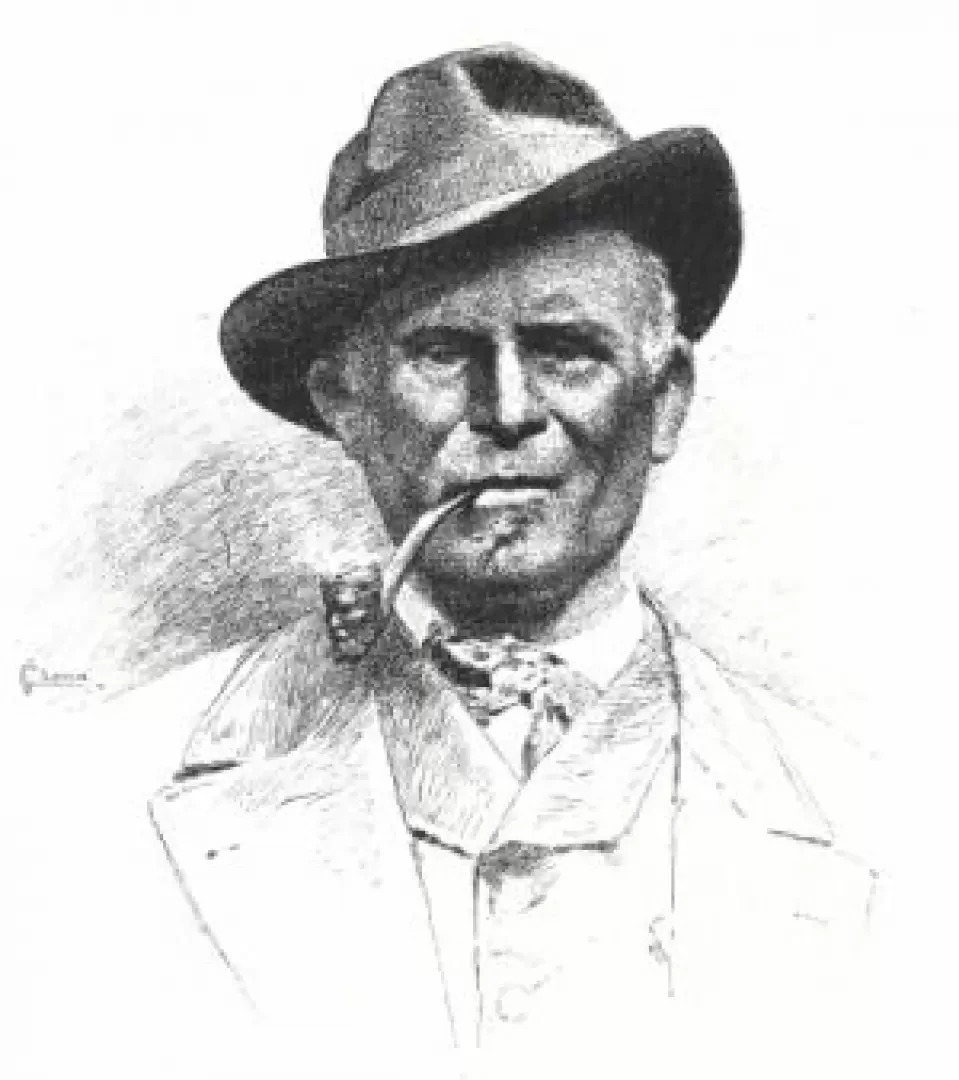
A mountain guide from Balme, in the Lanzo Valleys, with over forty first ascents to his name; he went missing on Mont Blanc in August 1890, along with Jean-Joseph Maquignaz and Count Umberto Scarampi di Villanova.
Personal details
name: Antonio Castagneri
pseudonym / nickname: Tòni dìi Toùni
date of birth: 17 January 1845 – Balme (Valli di Lanzo)
Died: 18 August 1890 – Mont Blanc
Nationality: Italian
Occupation: mountain guide
Biography
Antonio Castagneri was born on 17 January 1845 in Balme, at the head of the Val d'Ala, in the Lanzo Valleys. He belonged to the branch of the Castagneri family known as the Toùni, owners of the Pian della Mussa mountain pastures and, for this reason, linked for generations to the surveillance of the mountain passes towards Savoy, which were also used for smuggling. The nickname ‘Tòni dìi Toùni’ derives from this.
His first documented assignment as a guide dates back to 1867, when he accompanied Count Paolo di Saint-Robert on theUja di Ciamarella Count Paolo di Saint-Robert, one of the founders of the Italian Alpine Club. In the years that followed, he worked with mountaineers from Turin who were exploring the southern Graian Alps, in particular Leopoldo Barale and Luigi Vaccarone. Together with Vaccarone and Alessandro Emilio Martelli, on 24 December 1874 he climbed theUja di Mondrone: this is considered the first winter ascent carried out by Italian mountaineers, although an alternative interpretation attributes the first ascent to a climb in 1864 by the surveyor Antonio Laurent. In 1875, he guided Vaccarone on an expedition to Cogne and the Levanne, and in the same year, together with Alessandro Balduino, he opened the first Italian route on the Bessanese. In January 1878, he was one of the guides on the first winter ascent of Monviso.
From the 1880s onwards, his sphere of activity expanded to Monte Rosa, the Dauphiné and theOberland, largely with Guido Rey, who regarded him as his mentor and wrote a tribute to him. Together with Rey, he opened a route on the east face of Monviso in 1887 and on the north ridge of the Bessanese in 1889. In the statistics on first ascents compiled by Vaccarone, Castagneri ranked third overall with forty-three first ascents, preceded only by the two Christians Almer, father and son, and first amongst Italian and French guides. W.A.B. Coolidge, who was never his client but met him several times in the mountains from 1883 onwards, dedicated a tribute to him in the *Alpine Journal*.
In August 1890, the mother of the young Count Umberto Scarampi di Villanova entrusted her son to Castagneri and Jean-Joseph Maquignaz of Valtournenche. On the afternoon of 17 August, the three set off from Courmayeur to the Visaille hut to spend the night there, and at 3.30 am on the 18th they set off again towards Mont Blanc. They were never seen again. The CAI’s monthly magazine was unable to establish the route: questions posed by a guide from Courmayeur to Maquignaz suggested the route taken that year from the Dôme glacier side towards the Dôme du Goûter, whilst other accounts point to the Bionnassay ridge. The climbing party was probably caught unawares by the storm that broke out during the night of 18–19 August. The search operations, carried out on both sides of the mountain and repeatedly interrupted by snowfall, found only traces of their passage and the remains of a meal on the Chaut des Pesses; the bodies were never recovered. A week later, Jean-Antoine Carrel also died on the Matterhorn, and the CAI honoured the three guides in a single memorial service. Castagneri was forty-five years old and, according to Coolidge, left behind a wife and four young children.
Since 2002, the Balme Alpine Guides’ Ecomuseum has borne his name.
Mountaineering exploits
Uja di Ciamarella (3,676 m) - 1867 – with Count Paolo di Saint-Robert (Lanzo Valleys)
Charbonnel – 7 July 1870 – with Leopoldo Barale and the guide Giorgio Vicendet, from Avérole (Alta Moriana)
Uja di Mondrone – 24 December 1874 – first winter ascent, with Alessandro Emilio Martelli and Luigi Vaccarone (Lanzo Valleys)
Gran Paradiso via the Noaschetta Glacier and Becco della Tribolazione - 1875 – with Luigi Vaccarone (Gran Paradiso massif)
Bessanese, east face and south ridge – July 1875 – first ascent from the Italian side, with Alessandro Balduino (Lanzo Valleys)
Montandayné, north-west spur and west face – 22 August 1875 – first ascent of the route, with Luigi Vaccarone, A. Gramaglia and the guide Daniele Castagneri (Gran Paradiso group)
Matterhorn (4,478 m) – 1876 – with Quintino Sella
Uja di Ciamarella (3,676 m) - 23 January 1877 – first winter ascent, with Luigi Vaccarone, Antonio Boggiatto and other companions (Valli di Lanzo)
Monviso (3,841 m) - 22 January 1878 – first winter ascent, with Leopoldo Barale and the guides Giuseppe Castagneri and Antonio Boggiatto (Cottian Alps)
Torre d'Ovarda, north face – September 1878 – new route, with Antonio Hatz (Lanzo Valleys)
Monte Rosa, south face – 1886 – variant of the Hulton route; in the same year, ascent of the Jägerhorn via the south-east face (Monte Rosa massif)
Monviso (3,841 m), east face – 1887 – new route, with Guido Rey (Cottian Alps)
Bessanese, north ridge – 2 September 1889 – first ascent of the ridge, with Guido Rey (Lanzo Valleys)
Mont Blanc (4,808 m) – 18 August 1890 - went missing with Jean-Joseph Maquignaz and Count Umberto Scarampi di Villanova during the ascent from the Italian side
Places and commemorations
“Antonio Castagneri” Alpine Guides Ecomuseum - Balme, Lanzo Valleys – opened on 30 November 2002, it traces thework of the Balme guides and the history of the village
commemorative plaque - Balme, beside the parish church
Bibliography
As a writer
no documented works of his own
As a significant reference
W.A.B. Coolidge, in memory of Antonio Castagneri, The Alpine Journal, vol. XV, 1890–1891
Giuseppe Garimoldi, The Origins of Turin Mountaineering, Turin, National Mountain Museum, Cahiers series
Various authors, Antonio Castagneri: Mountain Guide, Turin, National Mountain Museum, Cahiers series, no. 73 (with texts by Guido Rey, Giuseppe Garimoldi and Giorgio Inaudi)